

“Give me the short version” and “help me use this later” are different requests. A summary compresses a source into its main point. Structured notes keep the pieces a person may need to inspect, compare, reuse, or act on. Neither result is always better. The useful choice depends on what happens after you read it.
This guide gives you a practical decision rule and a small matrix you can reuse. A source-to-structured-document workflow can produce a readable intermediate document first, while What is a Recap Document? explains how that result connects to the next step. For the full framework, see From Raw Source to Structured Document.

What a summary is good at
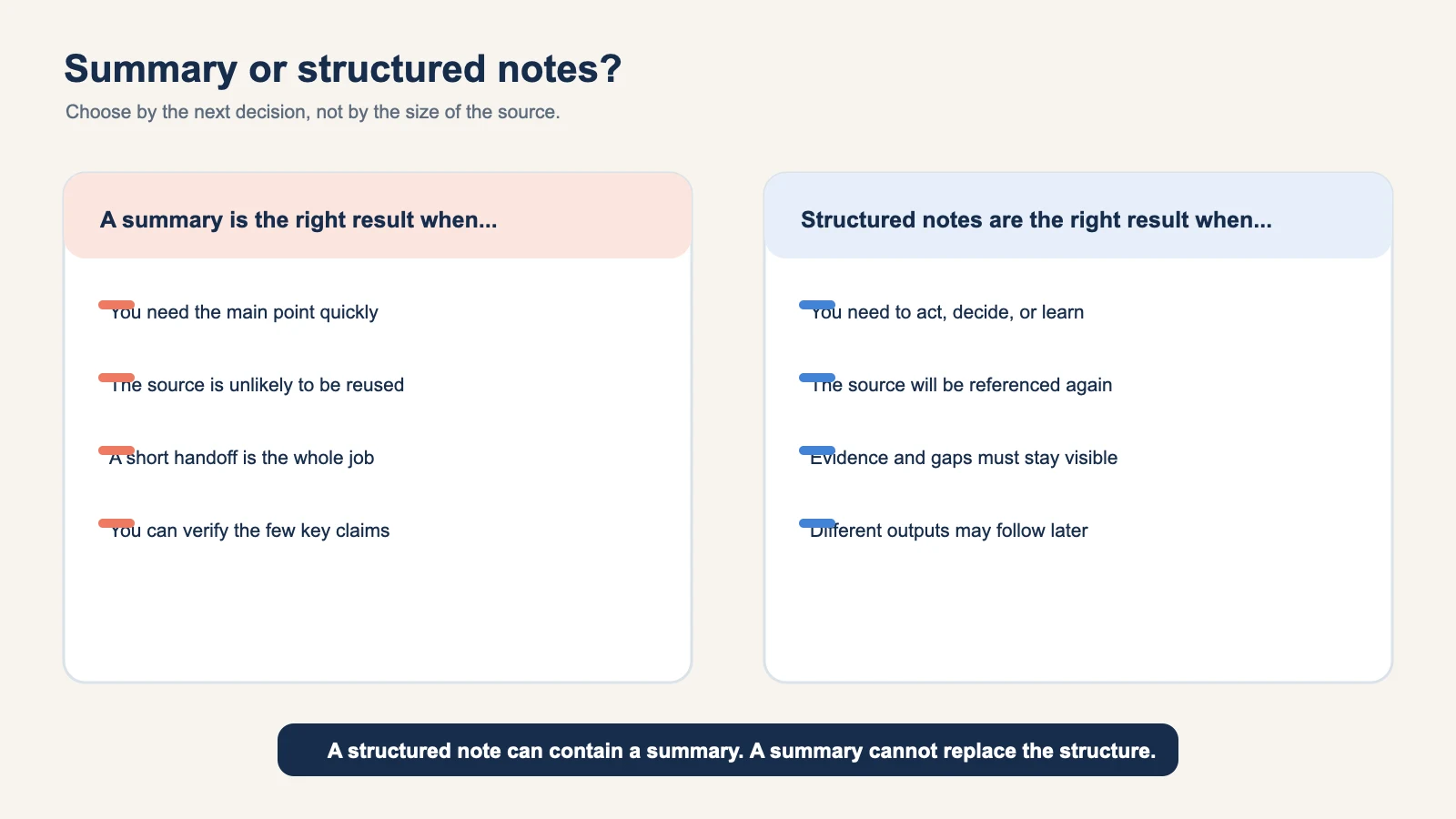
A summary answers “what is this mostly about?” in a small amount of space. It is a good fit when:
- you need the main point before a meeting;
- the source will not be reused;
- a short handoff is the complete job;
- only a few claims need checking.
The best summaries still name the source and its scope. A paragraph that omits the date, publisher, or limitations may be shorter but harder to trust. Keep the original link or file next to the text.
Summary length should follow the job, not a fixed ratio. A two-page decision memo may need three sentences for a handoff and a page of structured notes for the person who must implement it. The short result and the detailed result can coexist when their audiences differ.
What structured notes add
Structured notes keep a source useful after the first read. They can include:
- the source and the scope reviewed;
- facts with page, timestamp, or message context;
- interpretation separated from quotation;
- options and trade-offs;
- dates, owners, and next steps;
- open questions and missing evidence.
This is not an invitation to copy everything. It is a way to give each useful fact a place. A reader can skip the detail and still see the summary, then return to the claim that needs checking.
The NIST AI Risk Management Framework treats context, documentation, and evaluation as parts of responsible AI work. The framework is not a note-taking recipe, but the same habit is valuable in everyday source processing: make it possible to see what was known, what was inferred, and what should be checked next.
Use the next action as the tie-breaker
Ask one question: Will someone need to do more than understand the main point?
Choose a summary when the answer is no. Choose structured notes when the answer is yes, or when the source is likely to be revisited.
| Need | Better first result | Why |
|---|---|---|
| Quick orientation | Summary | The reader needs the main point now |
| Team decision | Structured notes | Options, rationale, and open questions must remain visible |
| Calendar handoff | Structured notes | Date, time, zone, location, and confidence need separate fields |
| Future reference | Structured notes | Definitions, links, and source scope matter later |
| Study or teaching | Structured notes | Concepts, evidence, and questions support follow-up |
| One-time status update | Summary | The handoff is complete when the reader is informed |
Compare both results from the same source
Take a source you know well and write two outputs. A useful experiment is a short project brief or a public report.
The summary might say:
The report recommends a staged rollout, identifies two risks, and asks the team to review the measurement plan before launch.
The structured notes would retain the report title and date, the exact two risks, the assumptions behind the recommendation, the measurement questions, and the page or section for each claim. The quote above is a useful orientation. The notes are what you need when someone asks, “Which risk was that?” or “What does staged mean in this report?”
The comparison also shows why structure is not the same as length. A clear four-row table can be more useful than five pages of prose. A concise “unknown” label can be more honest than a paragraph that guesses at missing context.
A source-grounded format for structured notes
Use these headings when you are unsure where to begin:
- Purpose: why the source is being processed.
- Source: origin, date, version, and scope.
- Key facts: statements that appear directly in the source.
- Interpretation: what those facts mean for the current job.
- Open questions: gaps, conflicts, and assumptions.
- Next step: review, decide, send, export, or study.
This format works for a link, a PDF, a screenshot, or a message thread. For a screenshot with a time signal, keep the original image and map the date, start time, end time, time zone, and location separately. Calendar systems distinguish these fields for a reason. Google Calendar's event resource documents them as separate values.
When a summary should become a document
Start with a summary, then expand it when any of these signals appear:
- a reader asks where a claim came from;
- two sources disagree;
- an owner, deadline, or decision is missing;
- the source will be used in a later project;
- the next step could change a calendar or shared workspace;
- the material raises a question that needs evidence.
Expansion does not mean rewriting from scratch. Add the source card, turn claims into labeled fields, and expose the uncertainty. The summary can remain at the top as the quick read.
Where Recap fits
Recap treats a source-grounded, structured document as the point before the destination. When the useful result is a time-bearing action, you can review a Calendar Sheet before sending. When the result belongs with project material, use source-to-workspace. When the goal is deeper understanding, use source-to-PBL Learning.
That sequence avoids a false choice between “summary” and “everything.” The document can hold a short overview, the evidence that supports it, and the next step the reader chooses. You stay free to send only the part that is ready.
A final decision card
Use this card before you process a source:
- I need the main point only: write a summary and keep the source link.
- I need to act or decide: write structured notes with owners, dates, options, and gaps.
- I need to reuse the material: preserve definitions, evidence, and page or section context.
- I need to learn: keep questions, perspectives, and sources together.
A structured note can contain a summary. A summary cannot replace structure when the next reader needs to verify, decide, or act. Begin with the source-to-structured-document tool, choose the smallest useful mode, and expand only where the source demands it.
Continue in Recap
Turn this source into a Recap Document
Make it easier to read, then send time-based details to Calendar, export it to Workspace, or start PBL Learning.