

A note can preserve the author's words, restate the author's idea, or add your own interpretation. Labeling which one you wrote makes it easier to reuse the note without attributing your conclusion to someone else.
The distinction is useful in meeting notes, research, and source documents. It does not replace the citation rules of a school, publisher, or organization. Record the source and a location even when the note is in your own words.
One public passage, three types of note
The W3C Web Annotation Data Model, section 4.2.4, describes a selector that identifies text using a copy of the selected passage and nearby context. The examples below are built from that one public passage, reviewed on November 2, 2026.
| Type | Example note | What the source supports |
|---|---|---|
| Quote | The section describes “a range of text by copying it.” | Those exact words appear in the cited section. |
| Paraphrase | The selector uses selected text and surrounding context to identify a passage. | The section describes an exact selection, prefix and suffix. |
| Inference | A reader may find the extra context useful when a phrase repeats. | This is a reader's conclusion from the described method, not a measured user outcome. |
The quotation is deliberately short. The paraphrase keeps the subject and scope of the specification. The inference is labeled as a possible benefit; the cited section does not establish that a particular app uses the selector or that people complete a task faster.
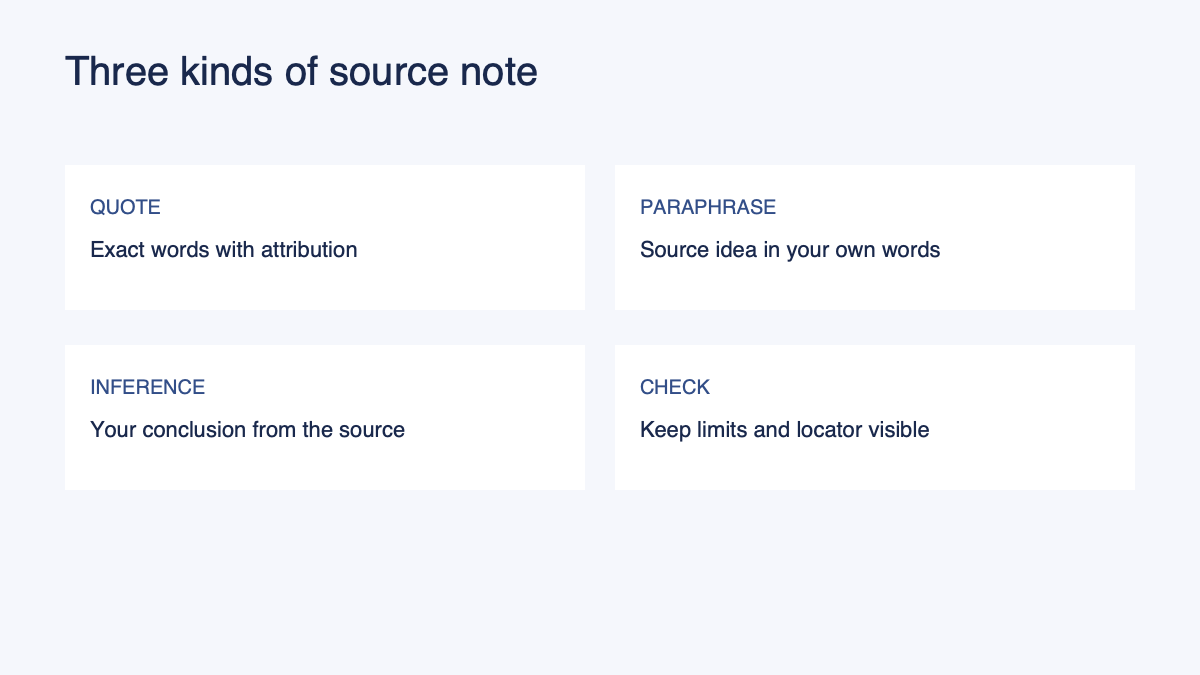
Quote when the wording matters
A quotation reproduces words from the source. Copy the relevant passage accurately, retain the author or organization, and add a locator such as a page, section, or timestamp. Use quotation marks or the format required by the applicable style. When your note leaves out surrounding material, check that the shortened excerpt still conveys the source's meaning.
Quoting is helpful when a definition, instruction, or particular turn of phrase needs close examination. It can also be useful when recording exactly what a person said in a meeting. Accuracy includes the words around a qualification: leaving out “may” or “for this group” can turn a cautious statement into a broad claim.
Keep quotations proportionate to your purpose. Access to a page does not automatically settle every question about copying or republication. If your note will be shared publicly, check the relevant rights and permissions rather than assuming that an internal research copy can be republished in full.
Paraphrase the idea, then check it
A paraphrase restates a source's point in your own words and structure. It still needs attribution. Texas A&M's University Writing Center recommends understanding the source, setting it aside while drafting, and checking the result against the original. The goal is to retain the author's meaning rather than merely replacing a few words.
Take the W3C example. The source describes an exact selection plus surrounding text. A note saying “the selector stores a whole document” would add a claim that this passage does not make. A note saying “all annotation apps use this selector” would also overreach: a specification describing a selector is not proof of a product's implementation.
Check the subject, action, amount, timeframe, conditions, and degree of certainty. If a source reports that a group considered an option, do not write that the group adopted it. If a passage describes a possibility, do not convert it into a guaranteed result. These checks matter even in private notes because the note may be reused months later without the surrounding context.
The APA Style in-text citation overview points to separate guidance for paraphrases and quotations. Your final citation format depends on the style and source. The source link in a working note helps you return to the passage, while the finished work may require additional publication details.
Label an inference as yours
An inference goes beyond a direct restatement. It connects an observation to a possible implication, explanation, or prediction. It can help you decide what to investigate next, provided its status remains clear.
For the W3C passage, “surrounding context may help distinguish repeated text” is a reasonable inference from the described design. “The method reduced review time by 30%” would need evidence that the passage does not provide. Mark the latter as unsupported unless you locate an appropriate study and verify its scope.
A compact inference record has four parts: the observed source statement, your interpretation, the reason you connect them, and a possible alternative. For example, repeated wording may make a passage hard to locate; a prefix and suffix could help distinguish it. The alternative is that the surrounding text also repeats or changes. In that case, the locator might still require review.
Use a simple note label
A working register can use these fields:
| Field | Example |
|---|---|
| Source and locator | W3C Web Annotation Data Model, section 4.2.4 |
| Source observation | Selected text is described with surrounding context. |
| Note type | Paraphrase |
| My interpretation | Context may help when the selected words repeat. |
| Limit | No evidence here that a particular product implements the selector. |
| Next check | Inspect the product's documentation or test its behavior. |
Keep a quotation separate from your own sentence even when you save both in the same paragraph. When copying notes into another document, preserve the labels and links. If you later remove a row, check whether the remaining text now appears to attribute your interpretation to the original author.
Handle mixed notes and missing context
Some notes contain more than one type. A sentence may begin with a paraphrase and finish with an inference. Split it into two sentences or mark the transition: “The specification describes X. This may help with Y.” Cite the source near the supported statement, and explain that the second sentence is your interpretation.
If the source is a video or conversation, identify the speaker as well as the uploader or note taker. Record the time and enough surrounding context to distinguish a reply from the question it answers. If the speaker is unclear, say so. An automatic transcript may make an error, so check important wording against the recording when possible.
When a passage is missing, do not reconstruct it from your memory and label it a quote. Keep your recollection as an unverified note and locate the source before using it as evidence. If the source has changed, record the edition or access date you actually reviewed and check whether a preserved version is available to you.
Put the distinction to work
Use the evidence locator template to keep source, passage, status, and limits together. The source-grounded document checklist helps review an entire note, while the source-to-structured-document guide gives the broader source-first context.
For a final review, ask a colleague to point to the source for each attributed claim. Then ask which conclusions belong to the author and which belong to you. If either answer is unclear, adjust the note before it becomes a citation or a decision.
Questions
Does a paraphrase need a source?
Yes. Changing the words does not make the underlying idea yours. Give credit using the citation method required for the work.
Can an inference appear in a source-based document?
Yes. Identify it as your inference and show the observation it relies on. State what remains unknown and avoid presenting an untested implication as a measured result.
Can a short phrase remain unchanged in a paraphrase?
Some terms are difficult or impossible to replace accurately. Follow your citation style and use quotation marks where appropriate for distinctive copied wording. Keep the underlying source clear.
Continue in Recap
Turn this source into a Recap Document
Make it easier to read, then send time-based details to Calendar, export it to Workspace, or start PBL Learning.