

A single notice can give two different answers to the same question. If one paragraph says a fee is $20 and another says $30, preserve both passages and ask for clarification before treating either amount as settled.
A contradiction may have an explanation: the amounts could apply to different groups, dates, or options. The source needs to establish that explanation. Until then, keep it as a question in your notes.
A synthetic notice with two amounts
The following notice is fictional and was created for this exercise. It does not describe a real event or fee.
Harbor Workshop notice
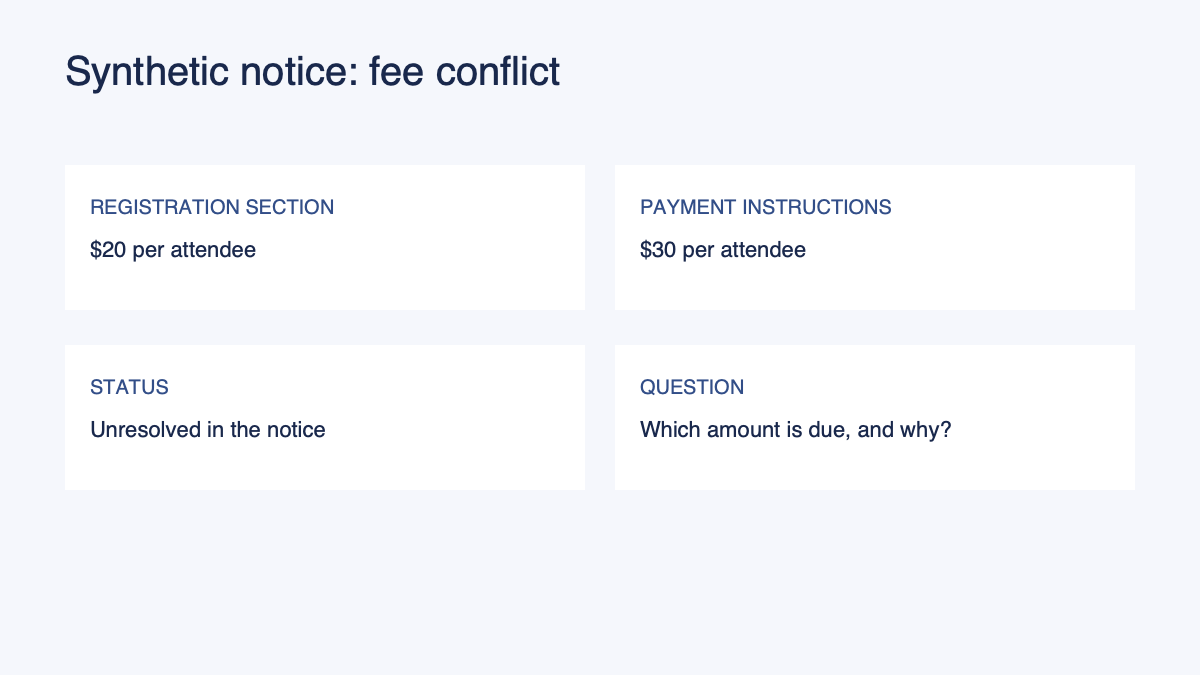
Registration: The workshop registration fee is $20 per attendee.
Payment instructions: Send $30 per attendee with your registration form.
Contact: Ask the workshop organizer about payment before submitting the form.
The two passages appear to address the same fee and the same attendee unit, but give different amounts. The notice does not state an early rate, a separate service charge, or a reason for the difference. Those are possible explanations to investigate, not facts established by this source.
A note that picks $20 would leave out the conflicting payment instruction. A note that adds the two numbers would invent a $50 total. A note that assumes the $30 includes a $10 charge would also add a detail absent from the notice. The safe record retains the disagreement and the next question.
Build a conflict register
| Field | Synthetic example |
|---|---|
| Source | Fictional Harbor Workshop notice |
| Statement A | Registration section: $20 per attendee |
| Statement B | Payment instructions: $30 per attendee |
| Common subject | Amount per attendee for registration and payment |
| Known scope difference | None stated in the notice |
| Potential consequence | Paying either amount without clarification could leave an unresolved balance or lead to an unintended payment. |
| Status | Unresolved conflict |
| Question | “Is the amount due per attendee $20 or $30, and does either figure include an additional charge?” |
| Next action | Ask the organizer before sending payment. |
The consequence is a planning concern inferred by the reader. The notice itself does not say an attendee will be charged a balance or receive a refund. Keep that distinction visible when forwarding the record.
For a real source, add the title, author or organization, link or file name, version, and date you accessed it. Add page numbers, section headings, or timestamps for both statements. If the source owner responds, retain the response and its date alongside the original notice. That lets another reader understand why the final decision changed.
Check whether the statements really conflict
Before contacting the source owner, compare the subject, unit, scope, and time period. Two values can differ without contradicting each other. A per-person fee and a group fee describe different units. A price for a member and a price for a nonmember may apply to different audiences. An old rule and a new rule may apply on different dates.
Do not fill those differences in yourself. Look for an explicit condition next to each amount and in the surrounding section. If the source contains a table footnote or an exception later in the document, add its locator to the record. If the passage refers to another document, record the reference and check whether you can access it.
A useful comparison asks:
- Do both statements describe the same thing?
- Are the amounts expressed in the same currency and unit?
- Do they apply to the same people, dates, and circumstances?
- Does a nearby qualification explain the difference?
- Is the document a single version, or are pages from different editions mixed together?
If one answer is unknown, keep that uncertainty in the register. It may be the question the source owner needs to answer.
Use context without hiding the discrepancy
Read each statement in its surrounding paragraph. A summary near the start may simplify a rule that is qualified later. A payment example may use a different quantity from the general rule. A diagram may contain a label that does not match the text. Context helps identify the scope, but a guess about intended meaning is not a correction.
The W3C Web Annotation Data Model describes identifying a text selection using the selected words and nearby context. In a manual note, a heading and a short surrounding phrase can play a similar finding role. This is a note-taking suggestion, not a claim that a particular app implements the W3C model.
For a PDF, distinguish the printed page number from the physical position in the file. For a video, preserve the two time ranges and speaker identities if known. If you paraphrase a passage, make sure the wording retains the source's condition and uncertainty. APA Style's citation overview points to separate guidance for paraphrases and quotations.
Ask a question that can be answered
A vague question such as “Which one is right?” may force the recipient to search for the conflict. Include both locations, quote or accurately paraphrase the relevant phrases, and state the decision you need to make. For the synthetic notice, the question in the register names both amounts and asks whether an additional charge is included.
If a real notice provides a contact path, use it according to the organization's instructions. Do not send a message until you have chosen an appropriate recipient and confirmed the information you are comfortable sharing. A reply can resolve the issue, but record who answered, when, and the scope of the answer. An informal response about one attendee may not establish a rule for everyone.
When no response is available, consider whether the decision can wait. If the decision has a deadline, record the deadline and the fact that the amount remains unresolved. Do not silently choose an amount because a form requires a number. If you must act, the choice and its basis belong in your decision record as your own judgment.
Keep the original and the resolution together
A corrected notice may replace the page you first saw. Keep the original locators and your access date in the record, and add the corrected version or response as a new entry. If you did not retain the old source, say that the earlier record is based on your notes. A later version does not prove exactly when the earlier text changed.
This is especially useful when another person asks why a payment or calendar action was delayed. The record should show what the source said, what was unresolved, and what later evidence supported the decision. Remove private details before sharing beyond the intended audience, and respect restrictions on copying the source.
The evidence locator template provides a reusable structure. Use the source-grounded document checklist to review the rest of a document, or start with the source-to-structured-document guide.
Questions
Should I average the two amounts?
No. An average is a new value, and the notice gives no basis for using it as the amount due. Record both amounts and ask the source owner.
What if the conflict is probably a typo?
Record “possible typo” as a hypothesis. A typo can be plausible without being verified. Ask the issuer or find an authoritative correction.
What if the two values refer to different groups?
If the source explicitly identifies those groups, record the distinction and their locators. If the groups are not stated, keep the question open.
Continue in Recap
Turn this source into a Recap Document
Make it easier to read, then send time-based details to Calendar, export it to Workspace, or start PBL Learning.