

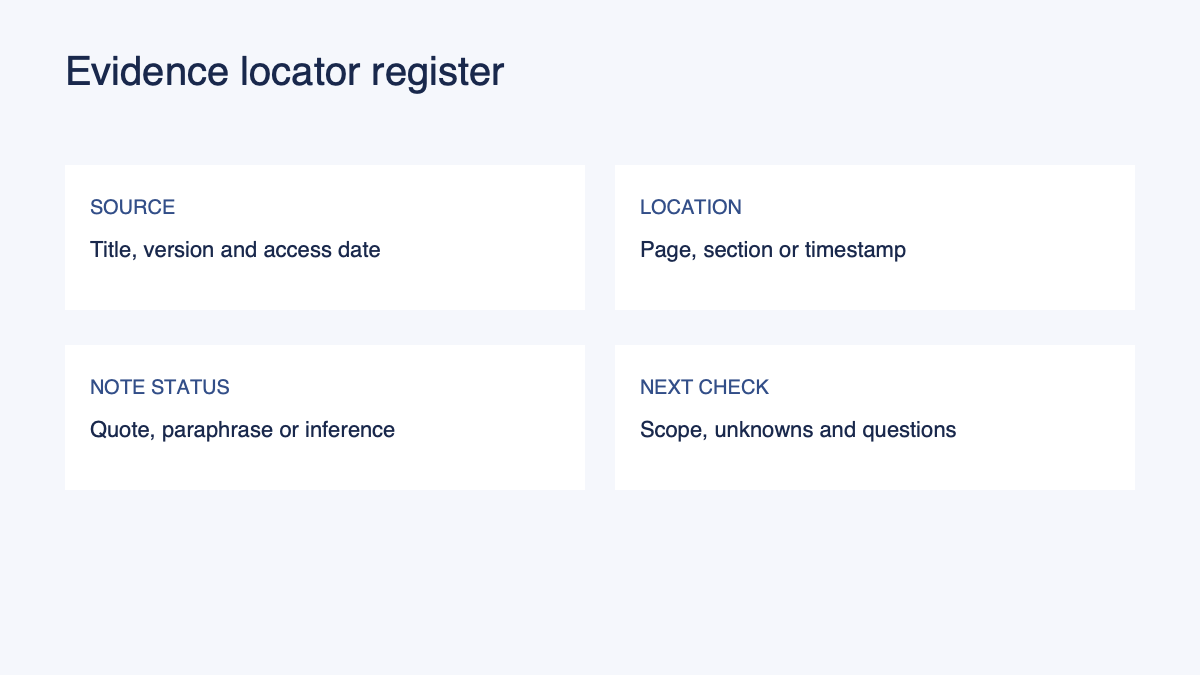
A note is easier to reuse when you can find the passage behind it. A link to the source is a start. A useful locator also tells you which version you read, where the passage appears, and whether your note is a quotation, a paraphrase, or your own inference.
This template is for one source at a time. Use it for a report, a video, a notice, or a web page when someone may need to check a detail later. It is a reading aid, not a citation style: follow the rules of your publication or institution when preparing a formal citation.
Copy the evidence locator register
Create one row for each claim you may need to check. Leave a field blank or write “unknown” when the source does not provide it.
| Field | What to record |
|---|---|
| Source | Title, author or organization, and the address or file name of the version you consulted |
| Version | Publication or update date if stated, plus the date you accessed the source |
| Locator | Printed page and PDF viewer page, section heading, paragraph, timestamp, or another useful position |
| Passage | A short exact excerpt or a description that helps you find the passage again |
| Note | The point you want to retain, in your own words where appropriate |
| Status | Quote, paraphrase, inference, or unknown |
| Scope | The conditions, audience, dates, or exclusions that limit the point |
| Next check | A question, missing reference, or person who can clarify the issue |
A row can be short. Its purpose is to make the next review faster, so include enough context to find and evaluate the passage without copying an entire document. For a long source, separate rows are often more useful than one locator attached to a whole paragraph of notes.
Choose a locator that survives the next reading
The right locator depends on the format. A PDF can have a printed page number and a different number in the viewer. Record both when the difference could confuse a reader: “printed page 3; viewer page 7.” A document with no page numbers may have a section heading and a paragraph. For a video, record a start time and, when useful, an end time. Name the version or edition alongside the location.
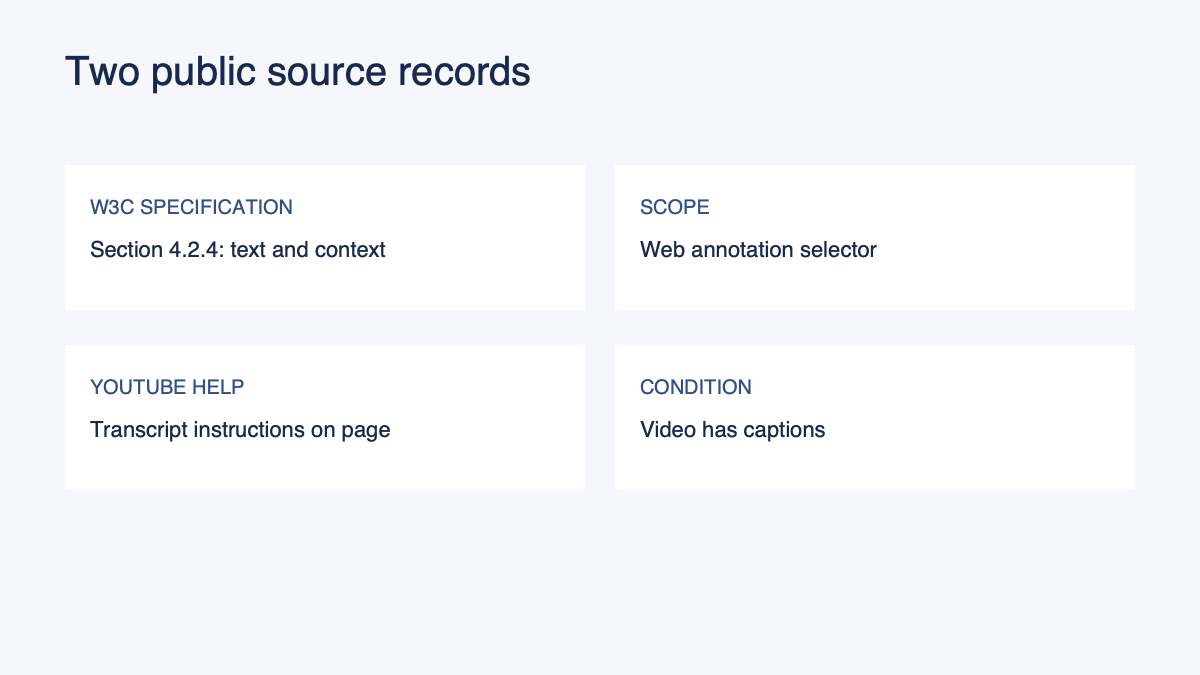
For a page that may change, a short quotation can help you find the passage even if surrounding text moves. Include the heading or nearby context if the same sentence appears more than once. The W3C Web Annotation Data Model describes a text quote selector that uses selected text and surrounding context to distinguish repeated passages. Its text position selector also warns that positions can become brittle when content changes. A personal register does not have to implement the standard; the useful lesson is to retain both location and context.
Do not invent a page number for a version that has none. The MLA Style Center advises citing the edition consulted rather than borrowing page numbers from a print edition you did not read. If your team uses a different citation style, check its rules, but keep the version you actually consulted clear in your working notes.
Worked example 1: a public web specification
The following example uses the W3C specification above. It records a reader's observation about a passage, not a product feature or a claim about every annotation tool.
| Field | Example record |
|---|---|
| Source | W3C, Web Annotation Data Model, https://www.w3.org/TR/annotation-model/ |
| Version | W3C Recommendation shown on the page; accessed November 2, 2026 |
| Locator | Section 4.2.4, “Text Quote Selector” |
| Passage | The section describes an exact text selection and surrounding prefix and suffix |
| Note | Surrounding text can distinguish identical selections in different places. |
| Status | Paraphrase |
| Scope | This describes the specification's selector; it does not establish that a particular app implements it. |
| Next check | If using an annotation tool, check its documentation and test its behavior. |
The final field prevents a common mistake: turning a standard's design into an unsupported claim that a specific product behaves that way. The source establishes what the specification says. A product test or first-party implementation evidence would be needed for the separate product claim.
If the same note will be used in a formal document, add the citation details required by the applicable style. The APA Style in-text citation guidance describes acknowledging sources and provides separate guidance for quotations and paraphrases. A locator in your working register helps you return to a passage; it does not replace the citation that your readers need.
Worked example 2: a public help page
A video note may need both a time and a transcript context. For this example, the source is not a video: it is YouTube's public help page explaining its transcript interface. That distinction is part of the record.
| Field | Example record |
|---|---|
| Source | YouTube Help, View video transcripts |
| Version | Date not stated in the passage; accessed November 2, 2026 |
| Locator | “View video transcripts,” opening paragraph and desktop instructions |
| Passage | The page describes opening a transcript and selecting a caption line |
| Note | A viewer can select a transcript line to jump to its corresponding part of a captioned video. |
| Status | Paraphrase |
| Scope | The help page discusses videos with captions; it does not promise transcripts for every video. |
| Next check | For a particular video, check whether captions and the transcript are available. |
If you later watch a specific video, create a separate record for that video. Include its title, creator, URL, and the time range you actually reviewed. The help page explains a feature; it is not evidence for the contents of an unrelated video.
Mark what kind of note you wrote
A quotation reproduces the source's words. Check spelling and punctuation against the passage, put the excerpt in quotation marks or the format your citation style requires, and retain attribution. Quote only what you need. If the material is restricted, consider whether you have the right to copy or share it.
A paraphrase states the source's point in your own language. It still needs attribution. Check that your wording does not change who did what, the amount, the timeframe, or the level of certainty. “Some participants reported a problem” is different from “all participants had a problem.” A good locator makes that difference easy to verify.
An inference is a conclusion you draw from the source. It can be useful, but a reader should be able to tell that it is yours. Write the source observation first, then the inference, and add what would change your mind. For example, if an announcement lists a deadline but does not say why it was chosen, “the organizer may need processing time” is a hypothesis, not an organizer statement.
Use “unknown” when the passage leaves a field unanswered. A blank year, unspecified audience, missing denominator, or unlinked original study should remain visible. You can record a candidate answer in a separate field, labeled as an assumption to check.
Keep the source and note close, without merging them
The register works best beside the readable document it supports. Start with a short note, then attach the row that lets you find the supporting passage. For a paragraph containing several claims, make several rows or give each claim its own locator. A single link at the end of a page may be too broad when the underlying report has dozens of sections.
When a source is private, a link may work for you but fail for a colleague. Record the access limitation and ask the owner for a shareable copy or permission before forwarding an excerpt. Do not assume that access to a source includes permission to republish it.
For a source that changes, keep the date you read it and any version identifier shown by its publisher. If you make a local copy, label it with the date and ensure you are allowed to retain or share it. A later visit to the same URL may show different text. Your access date is the day you checked; it is not a publication date or proof of when the author changed the page.
A quick review before handing off the note
Read each row against the source. Can a second reader find the passage? Does the note keep the same subject and scope? Is a direct quotation clearly marked? Have you separated your interpretation from the author's statement? If a source says two different things, preserve both locations and write the question you need answered rather than selecting the convenient one.
For PDFs, use the page number check. For video, use the timestamp review. The source-grounded document checklist helps review the document as a whole.
A structured document can then be reviewed for the next useful action. The source-to-structured-document guide describes the initial document, What Is a Recap Document? explains its role, and source to Workspace covers a handoff to an existing workspace. Keep the evidence record available whichever next step you choose.
Hand the register to another reader
Before a handoff, try a small test with one row. Give the reader the source and your locator, then ask them to find the passage without directing them to it. If they land on a different paragraph, add the heading or surrounding context that distinguishes the intended passage. If they cannot open the source, the problem is access, not the wording of the locator. Ask the source owner for an appropriate way to share it.
Then ask the reader to describe what the source actually supports. They may read a condition or exception differently from you. Compare both readings with the passage and record any unresolved disagreement. A locator makes the discussion more concrete, but it does not settle interpretation on its own.
The register also helps when a decision changes. Keep the earlier row with the date it was checked, then add a new row for the later source or correction. Record which decision the new evidence affects. If the two records describe different versions, avoid presenting the later passage as if it had been available in the earlier version. This history can be short: a title, locator, date, and explanation of the change are often enough for the next reader to understand why the note was revised.
Frequently asked questions
Is a URL enough as a locator?
Sometimes, especially for a short stable page. Add a heading or short excerpt if the page is long or may change. For a video or PDF, a time or page usually makes a particular passage easier to find.
Should every note have an exact quotation?
No. A short paraphrase and a precise locator may be enough. Use an exact quotation when the wording matters and you can reproduce it accurately. Follow the applicable citation and reuse rules.
What if a passage has no date or page number?
Record the information you can see and mark the missing detail as unknown. A section heading, nearby phrase, or paragraph description may serve as a locator. Avoid substituting a date or page number from a different version.
Can an inference be included?
Yes. Label it as your inference, identify the observation it relies on, and state its limits. If the conclusion requires information absent from the source, record that gap as a next check.
How much context should I keep?
Keep enough to distinguish the passage from a similar one. A heading, a short surrounding phrase, and the edition are often more useful than a long copied passage. Check any restrictions on retaining or sharing the original material.
Continue in Recap
Turn this source into a Recap Document
Make it easier to read, then send time-based details to Calendar, export it to Workspace, or start PBL Learning.