

Turn a note into a prompt you can answer
Notes preserve information, but a list of statements can be hard to study. A learning question gives each note a task: recall a fact, explain a relationship, compare ideas, test a boundary, or connect the source to something you already know.
The change can be small. Start with one note that matters. Circle its main idea, then ask what a reader would need to explain or remember. Keep the answer close to the source so the prompt does not drift into guesswork.
Begin with the note's role
First identify what kind of note you have. Different notes lead to different questions.
- A fact: ask what it means or why it matters.
- A process: ask what happens first, what changes next, and why.
- A comparison: ask what the options share and where they differ.
- A claim: ask what evidence supports it and what it does not establish.
- A decision: ask what condition would change the choice.
- An open question: ask which source or detail could resolve it.
This classification is a practical sorting step. It is not a formal taxonomy. If a note contains several claims, split it before writing a question. One prompt should have one answer that can be checked.
A before-and-after example from a published study
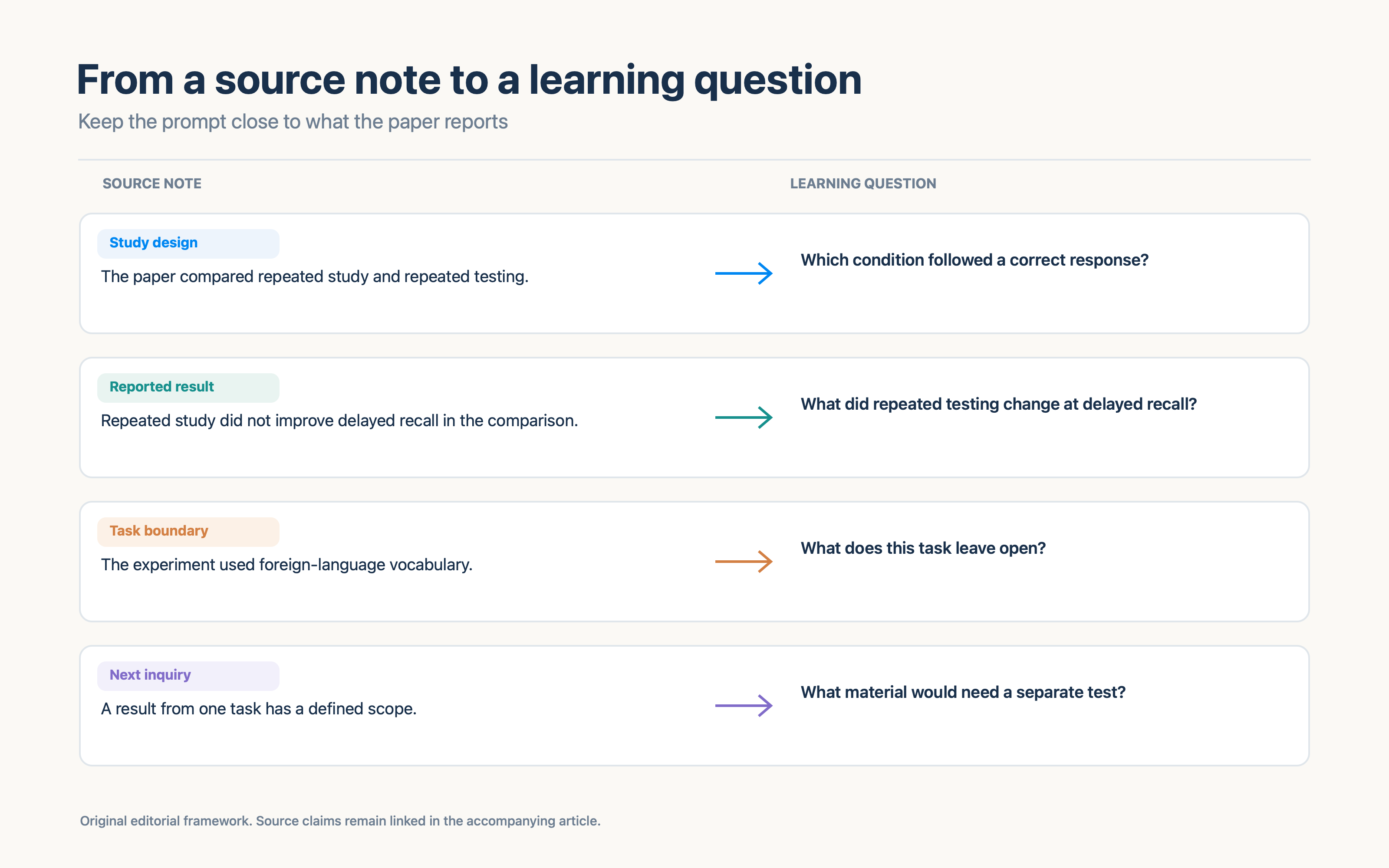
Consider this source-based note: “Karpicke and Roediger compared repeated study with repeated testing after students learned vocabulary items.” The published paper reports that repeated studying after a correct response did not improve delayed recall, while repeated testing produced a positive effect in their experiment. Karpicke and Roediger, 2008
The note can become a sequence:
| Note type | Learning question | Source check |
|---|---|---|
| Study design | What changed between the repeated-study and repeated-test conditions? | Read the paper's method and condition descriptions. |
| Result | What did the researchers report about delayed recall? | Locate the result section and keep its wording precise. |
| Explanation | Why might attempting to recall differ from rereading? | Mark this as an explanation to evaluate, not a sentence quoted from the result. |
| Boundary | Does this experiment establish the same effect for every kind of material? | Check the participants, materials, and task before extending the claim. |
| Reflection | What would I need to see before using this approach in another setting? | Find evidence for the new setting or label the question unresolved. |
This table uses the paper as a worked example. It does not invent an effect size or claim the same outcome for a different group. A good question leaves room for the source to answer “the study does not tell us.”
Use a five-move conversion
Move 1: Keep the source language available
Copy the note and retain its citation, source location, or document link. If you cannot find the original statement, check whether the note is a summary from memory. That may still be useful, but mark it as unverified.
Move 2: Find the relationship
Look for words such as because, compared with, led to, depends on, and unless. These often point to the idea a question should test. If the note has no relationship, ask what a reader needs to remember about the fact.
Move 3: Choose a prompt verb
Use a verb that matches the work:
- Recall: What happened? Which term describes it?
- Explain: Why might this be true? How do the parts fit?
- Compare: How is this different from the alternative?
- Apply: Where would the same idea matter in a new example?
- Challenge: What evidence would weaken the claim?
- Reflect: What remains unclear?
The verb gives the learner a clue about the answer they need. A vague question such as “What do you think?” may invite reflection, but it does not always show whether the source supports the response.
Move 4: Write a short answer key
A good prompt can be checked. Draft a concise answer and include the source location. If an answer needs a paragraph, split the question into smaller parts or point to the relationship that matters most.
Move 5: Test the prompt away from the note
Cover the original note and try to answer. Then reopen the source. If you could answer only by guessing, sharpen the question or add a cue. If the prompt repeats a sentence word for word, ask for an explanation or connection instead.
Ask for an explanation, then check it
A line of research on self-explanation suggests that prompts to explain can help some learners build a stronger understanding of an expository text. In a study of eighth-grade students reading about the circulatory system, the self-explanation group showed a greater pretest-to-posttest gain than a group that reread the passage. The study had 14 prompted students and 10 controls, so the result should be read within that setting. Chi et al., 1994
Another set of experiments examined elaborative interrogation, where learners generate an answer to why a fact is true. In six studies involving children, Wood and colleagues reported stronger recall for elementary students instructed to generate their own elaborations than for students who studied supplied elaborations or repeated the facts. They also reported that prior knowledge mattered. A why-question can be difficult when you lack the background needed to answer it, so check whether the source gives enough context. Wood et al., 1993
These findings support trying explanations and why-questions. They do not validate every prompt in the conversion table. If the learner cannot answer, add a small source excerpt, term definition, or example as a cue. Then return to the question and see whether the answer can be reconstructed.
Use a small question set
A study session does not need one question for every sentence in your notes. Select a few prompts that cover different kinds of understanding:
- One recall question for the central fact.
- One explanation question for the most important relationship.
- One evidence question for the source support.
- One challenge question for a limitation or alternative.
- One reflection question for the next thing to learn.
Mark which answers you can recall, which need checking, and which remain open. This helps you avoid polishing prompts that do not serve your goal.
Keep the question attached to the evidence
Notes often outlive the page where they came from. Store the source title and a useful location with each question. For a PDF, that might be a page and section heading. For a web document, keep a link and heading. For a meeting note, preserve the date and the specific record. Avoid making a question sound more certain than its source.
If a tool helps turn notes into questions, review the transformation. Check that it did not merge two separate claims, turn a possibility into a fact, or remove a qualifying phrase. A polished prompt can still point to a weak answer.
Check a question before keeping it
Read the prompt once without looking at the note. Is it clear what kind of answer it asks for? Does the answer have a source location? Can the learner tell whether a response is correct, incomplete, or uncertain? If one prompt asks for several things, split it. If two prompts lead to the same answer, keep the clearer one. A smaller set with different jobs is easier to revisit than a long list of near-duplicates.
Question wording can also shape the depth of a discussion. Alison King's classroom study trained pairs of fourth- and fifth-grade students to generate questions and explanations about science lessons. The group whose prompts also connected lesson ideas to prior knowledge showed more complex knowledge construction than the comparison conditions. This was a classroom study with a defined age group and lesson context, so treat it as support for designing prompts, not proof for every note workflow. King, 1994
Continue in Recap Learning
Recap turns a selected source into a structured document before presenting next steps. Learning is available as one option when a source deserves deeper study. Its current flow presents question cards from several perspectives and organizes selected answers in a mind map. You can use a card as a starting prompt, then return to the source and confirm the evidence.
For a practical sequence, see how to learn from a source with PBL, or try Recap's Source to PBL Learning tool. If you are still preparing the material, begin with source to structured document. For a wider view of question types, see the guide to educational taxonomies.
Continue in Recap
Turn this source into a Recap Document
Make it easier to read, then send time-based details to Calendar, export it to Workspace, or start PBL Learning.