

Treat every answer as a claim to check
An AI answer can be clear and still misread a source, merge two statements, or fill a gap with information that was not in the document. A useful learning answer should let you return to the material and see how the explanation was built.
This checklist is a practical verification aid. It has not been tested as a formal scale. Use it for AI-assisted explanations, generated study questions, or notes written after reading. If a claim cannot be checked, keep it provisional or remove it.
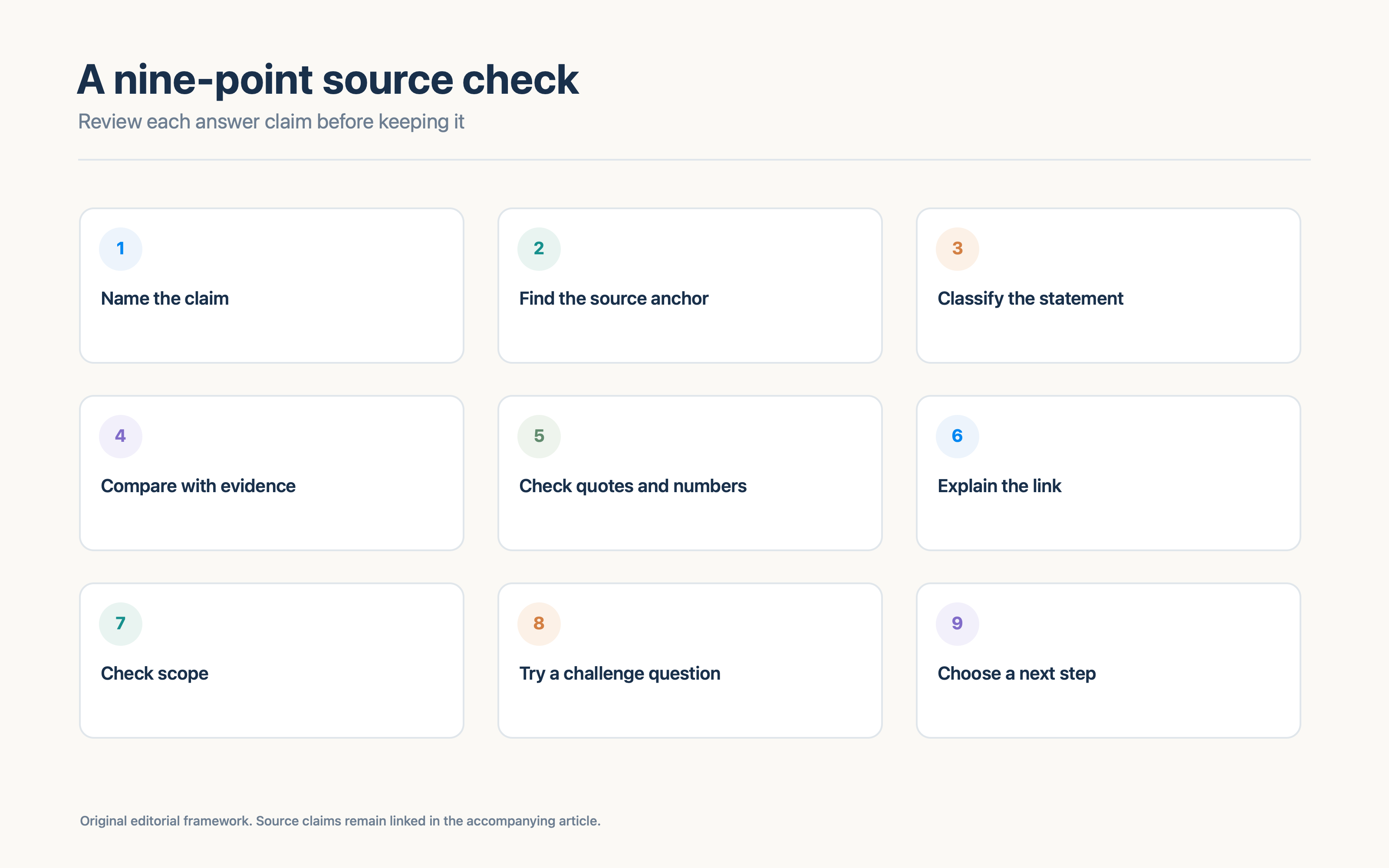
The source-evidence checklist
1. Name the claim
Underline one factual claim in the answer. If a sentence contains several claims, split it. A source location can support one clause while leaving another unsupported.
2. Find the source anchor
Record a page, section, heading, table, or figure. Reopen the location and read enough surrounding text to preserve the meaning.
3. Classify the statement
Mark the statement as one of these:
- Direct: the source says this explicitly.
- Paraphrase: the source makes the point in different words.
- Inference: the answer draws a conclusion from source material.
- Outside context: the answer adds information from elsewhere.
The label matters. An inference can be useful, but it needs evidence and reasoning. Outside context needs its own source.
4. Compare answer with evidence
Does the source support the whole claim, or only part? Check names, values, dates, group descriptions, conditions, and qualifying words. Small edits such as “may” to “does” can change the conclusion.
5. Inspect quotations and numbers
Compare every quotation word for word. Recheck every number, page reference, and unit. If the PDF viewer's page number differs from the printed number, say which one you used.
6. Check the explanation
Can you describe why the evidence supports the answer? Keep this explanation separate from the source wording. If the link is not clear, write what is missing.
7. Look for scope and uncertainty
Who or what does the source cover? Which conditions, method, time period, or limitations shape the claim? Do not turn a result from one study into a rule for every learner or material.
8. Try a challenge question
Ask what alternative explanation, counterexample, or missing comparison could change your interpretation. Check whether the source addresses it. If it does not, record the issue as open.
9. Decide what happens next
Keep the answer, revise it, find another source, ask an expert, or stop. Preserve unresolved questions so they do not disappear inside a polished paragraph.
A worked check with a research claim
Suppose an answer says, “Retrieval practice is better than concept maps for learning.” That sentence is broader than the finding reported by Karpicke and Blunt. Their 2011 paper compared retrieval practice with elaborative studying using concept mapping in science-text experiments and reported greater meaningful-learning gains with retrieval practice, including on comprehension and inference questions. Karpicke and Blunt, 2011
Use the checklist:
- Claim: What comparison did the authors test?
- Anchor: Where do the abstract, methods, and results describe it?
- Class: Is the sentence a direct finding, a paraphrase, or a broader inference?
- Scope: What materials and outcomes are in the study?
- Limit: Does the study answer whether concept maps help in another task or for another learner?
- Next step: Read the methods before applying the result to a new context.
The revised note might say: “In their science-text experiments, Karpicke and Blunt reported greater meaningful-learning gains from retrieval practice than from elaborative concept mapping.” This version identifies the authors' result and its setting. A separate sentence can state an interpretation, with a label.
Use explanations without hiding the source
Self-explanation asks a learner to connect material to an explanation. Chi and colleagues studied eighth-grade students learning about the circulatory system from an expository text. Students prompted to explain after reading each line showed a greater pretest-to-posttest gain than students who read the text twice. The study is informative about a specific passage and group; it does not show that an AI answer can replace checking a source. Chi et al., 1994
When you use an AI-generated explanation, write one sentence in your own words and return to the source. If the source supports only part of the explanation, narrow the claim. If the explanation depends on knowledge outside the source, attach a separate citation or mark the addition.
Question generation also depends on support and prior knowledge. In an experiment with undergraduates reading multiple primary-source documents, Cameron, Van Meter, and Long found that students without instruction generated fewer higher-order integration questions than students who received question-generation instruction. The finding concerns those participants and materials. It is a reminder to review question quality rather than assuming every generated question prompts deep reasoning. Cameron, Van Meter, and Long, 2017
Ask for an auditable draft
If you use a language model to draft questions or answers, make the request specific:
Use the provided document as the source for factual statements. For each claim, include its page, section, heading, table, or figure when available. Separate source statements from interpretation and outside context. If the document does not answer a question, label it unresolved. Do not invent quotations, values, citations, or page numbers.
Treat this as a request for a draft, not a guarantee. Check the output against the original document. A citation-shaped string or a plausible page reference can still be wrong.
Keep an evidence trail small
You do not need a large research notebook for every source. Keep enough context to repeat the check:
- The source title and link or file name.
- The exact location of the evidence.
- The claim or question.
- A short answer in your own words.
- Any uncertainty or next source to inspect.
If you are studying a dense PDF, see how to read a PDF with better questions. To work through a difficult document, use these questions for close reading. For a reusable reading sequence, use the question ladder for source-based learning. If you are starting from unstructured material, try Source to Structured Document.
When two sources disagree, record both passages with their dates and definitions. Compare who or what each source covers, how each reached its conclusion, and whether one updates the other. When a question depends on recent product or policy details, check the current first-party source. A web answer may combine an older statement with a newer one, so date and scope belong in your evidence trail.
Use Recap as one step in the process
Recap first turns a source into a structured readable document. It then makes Calendar, Workspace, and Learning available as parallel next steps. Learning can help you explore a selected source through question cards and mind-map answers. You remain responsible for checking important statements against the source.
For source-led question exploration, try the Source to PBL Learning tool. For a broader preparation sequence, see the source-grounded AI study guide. When a question or answer needs stronger evidence, return to the original source and apply the checklist above.
Continue in Recap
Turn this source into a Recap Document
Make it easier to read, then send time-based details to Calendar, export it to Workspace, or start PBL Learning.