

Learning starts with a question worth resolving
A useful source gives you material to work with: a claim, a decision, a method, an event, or a problem. Reading every paragraph twice may still leave you unsure what the author established. A focused question gives the reading a job. It asks you to locate a claim, check its support, explain the idea in your own words, and decide what remains open.
Question-driven problem-based learning, or PBL, is one way to organize that work. In a source-based session, the source supplies the evidence and the problem supplies the direction. The learner moves between the two. The goal is a clearer understanding of this particular source, with a short list of next questions that deserve more reading.
This approach can be used with a research paper, a report, a policy document, a class reading, or a useful message. It does not require a course, a large project, or a long study plan. Choose a source that deserves attention, then work through a small number of questions that connect the source to an explanation or decision.
PBL describes a family of methods
PBL does not name one fixed classroom recipe. Howard Barrows described problem-based learning as a term that can cover different educational methods, with different designs, teacher roles, and objectives. That distinction matters when adapting PBL to independent reading. A short question session can borrow the useful pattern of starting from a problem without claiming to reproduce a full medical-school curriculum. Barrows, 1986
For an individual source, the problem can be modest. You might ask what a study found, whether a proposal follows from its evidence, how a process works, or which detail changes a decision. The source keeps the question concrete. It also gives you a place to check the answer.
A good session has four anchors:
- A source that can be reopened and checked.
- A question that points to a real information need.
- Evidence from the source, such as a passage, section, table, or figure.
- A learner explanation that connects the evidence to the question.
The explanation is a working interpretation. Keep it separate from a direct quotation and mark uncertainty instead of smoothing it away.
Question choice should follow the job you are doing. If you need a reliable fact, ask for a brief recall. If you need to understand a mechanism, ask for an explanation. If you need to use a result elsewhere, ask what would have to stay the same and what might change. Each question sets a different standard for the answer, so a single source can support one conclusion while leaving another open.
This is also why more questions are not automatically better. A useful prompt sends you back to the relevant part of the source or makes you reconstruct a relationship from it. A prompt that asks for an opinion without a source anchor can be a good discussion starter, but it is a different activity. Keep the source-based question and the open-ended discussion question in separate notes.
A six-step question ladder
The ladder below is an original working framework for reading one source. It is a practical sequence, not a validated assessment scale. You can stop after any rung if the source has answered the question you came to resolve.
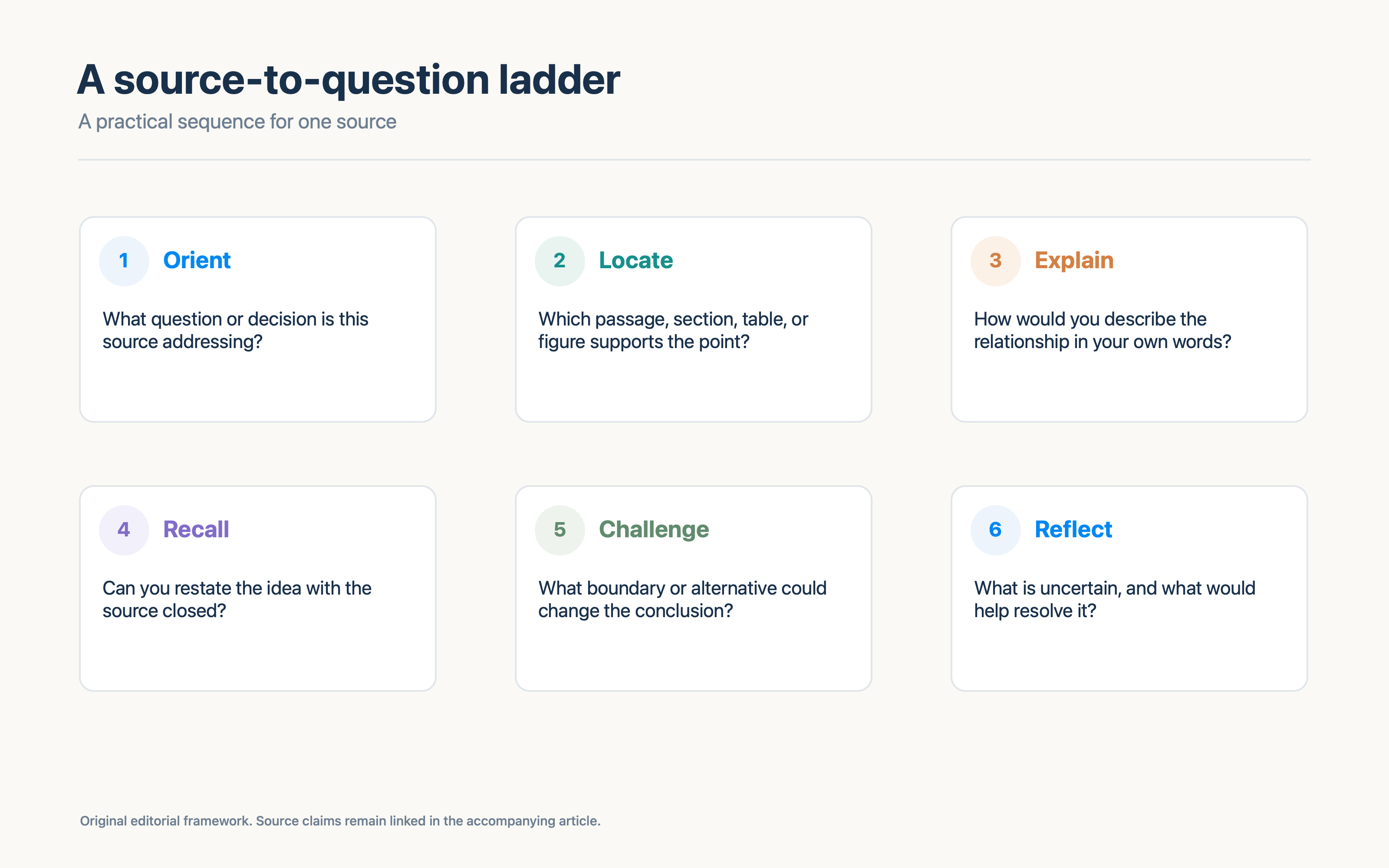
- Orient. What problem, decision, or question is this source addressing? State it in one sentence.
- Locate. Which passage, section, table, or figure is relevant? Save the exact location before paraphrasing.
- Explain. How would you describe the point to someone who has not read this source? Connect the pieces instead of repeating its vocabulary.
- Recall. Can you restate the main relationship with the source closed? Then reopen it and correct what you missed.
- Challenge. What boundary, counterexample, alternative explanation, or missing comparison could change the conclusion?
- Reflect. What is still uncertain? What specific source or answer would help resolve it?
These prompts move from orientation to evidence and then to your own model of the idea. The final two questions protect against a common reading mistake: treating a clear explanation as proof that every relevant issue has been settled.
A public research paper as a worked example
Karpicke and Blunt's paper, “Retrieval Practice Produces More Learning than Elaborative Studying with Concept Mapping,” is a useful public example because it reports a direct comparison. A copy of the paper is available through Yale's Center for Teaching and Learning, and the published abstract is indexed by PubMed. The study reports that retrieval practice produced greater gains in meaningful learning than elaborative studying with concept mapping across science texts; tests included comprehension and inference questions. Published abstract · Public paper copy hosted by Yale
Here is a careful first pass through the ladder:
- Orient: What does the paper compare? Its abstract frames a comparison between practicing retrieval and elaborative studying with concept mapping.
- Locate: Where is the result stated? Start with the abstract, then use the paper's methods and result sections to inspect the materials, conditions, and measures.
- Explain: What does the main claim mean? The authors report that trying to bring information back to mind can support meaningful learning, including on tests that require comprehension or inference.
- Recall: Close the paper and summarize the comparison from memory. If you remember only that “active study helps,” reopen the abstract: the result concerns retrieval practice compared with concept mapping in the reported experiments.
- Challenge: What should the paper not be used to claim? Its abstract does not establish that every learner, subject, or AI-generated question set will benefit in the same way. Read the method before extending the result to a different setting.
- Reflect: What would you inspect next? The experiment's participants, exact study procedure, test schedule, and supporting online material can sharpen how you interpret the result.
This summary stays within what the paper's abstract supports. If you use a number, sample detail, or result that the abstract does not report, verify it in the article before publishing or citing it.
Research on self-explanation offers a related, narrower example. In one study, 14 eighth-grade students were asked to explain ideas after reading lines about the circulatory system, while 10 students reread the passage. The prompted group showed a greater pretest-to-posttest gain. That is evidence about a small study using one text and one age group. It supports asking learners to explain, while leaving room to test whether a prompt fits a different source or reader. Chi, de Leeuw, Chiu, and LaVancher, 1994
Use questions to connect evidence and explanation
When reading a dense source, write one question for each important relationship rather than one question for every paragraph. “What changed?” may locate a result. “Why could that result follow from the method?” asks for a link. “Which detail supports that explanation?” sends you back to evidence. “What else could explain it?” tests the boundary.
Keep three kinds of statement visibly separate:
- Source statement: what the author says or what the study reports.
- Evidence anchor: where the source shows it.
- Your explanation: how you interpret the point, including what you infer.
A fourth note can capture uncertainty. For example: “The abstract reports an advantage on comprehension and inference questions; I have not checked how the test was administered.” This is more useful than turning a missing detail into a confident answer.
If a question is too broad, narrow it by pointing to a source location or a decision. “What is PBL?” could lead to an encyclopedia-style overview. “Which features of this problem-based learning paper matter for studying one document?” tells you what to look for and what not to generalize.
What Recap's current Learning flow shows
Recap's source-first flow begins with a structured Recap Document, then keeps Calendar, Workspace, and Learning available as next steps. When a source merits deeper study, Learning presents question cards grouped by perspectives. Selecting a question opens a concise answer structure in a mind map. A reader can compare perspectives, inspect the question and answer, and continue with a different question.
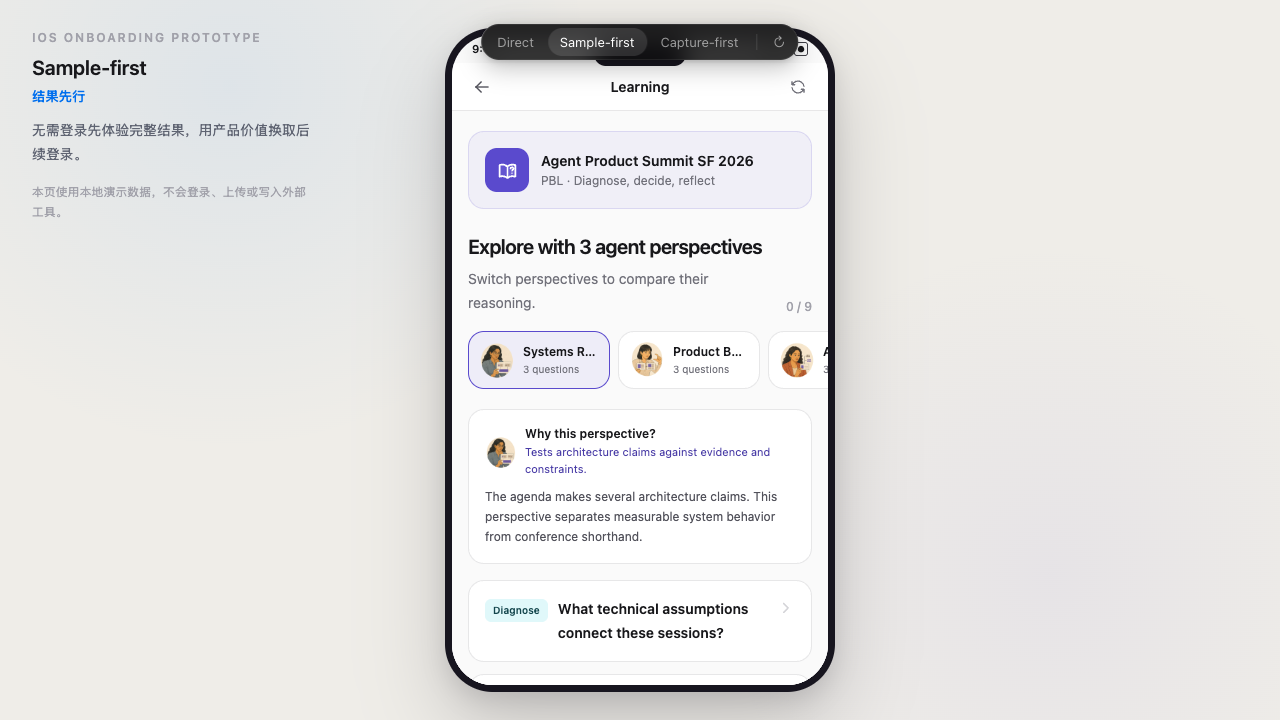
The image shows a first-party iOS onboarding prototype in sample-first mode: a sample conference source, question cards, and three perspectives. It uses local preview content. Treat it as an illustration of prototype interface design, not customer evidence, a published case study, or a production claim. The current web Learning implementation separately opens a selected question's concise answer structure in a mind map. In either flow, check the source itself to decide whether an answer is supported.
A useful way to bring the ladder into Recap is to select a question, inspect its answer, then reopen the cited source or source document. Mark which sentence or figure supports the answer. If the answer combines evidence with interpretation, keep those parts distinct. If a question does not fit your purpose, choose another card or return to the source.
A short session you can repeat
You can apply the ladder without turning reading into a separate project:
- Choose one source and write the decision or curiosity that brought you to it.
- Find the source's main question, claim, or recommendation.
- Select one point that matters to your need.
- Save the passage or section that supports it.
- Explain the point in your own words, then compare your explanation with the source.
- Close the source and recall the central relationship.
- Add one challenge question and one unresolved question.
- Stop when you have a grounded explanation and a clear next step.
The next step can be another source, a discussion with an expert, a calendar action, a workspace export, or simply no action. Keep the reading task aligned with the reason you opened the source.
When to pause or change the question
A source may not contain enough evidence to answer the question. It may refer to another paper, describe a recommendation without showing its basis, or leave an important term undefined. Write down that gap and look for the source it points to. Do not ask a model to fill the gap with confident prose.
You can also check whether the problem is in your prompt. If one question contains a claim, a comparison, and a recommendation, it may be asking for more than one answer. Split it into three prompts and keep the shared source location beside each one. If a term is unfamiliar, define it before judging the author's argument. If the source assumes background knowledge, find a primer or ask a subject expert, then return to the original source to see how the new context changes your explanation.
A question may also demand knowledge that the source does not cover. If you need a causal explanation but the paper reports only an association, make that limit explicit. If the source offers a short abstract but not enough method detail, leave the method question open until you read the full text.
Question-driven learning helps when it stays close to a real question and a checkable source. The question ladder gives you a way to move from reading to evidence, explanation, and reflection. Use it as a guide that can be revised as the source becomes clearer.
Continue with a source
Recap's Source to PBL Learning tool helps turn selected sources into question-led exploration. Start from a structured document, learn what a Recap Document is, or review Recap plans before choosing a workflow.
Continue in Recap
Turn this source into a Recap Document
Make it easier to read, then send time-based details to Calendar, export it to Workspace, or start PBL Learning.