

Start with the job the document needs to do
When a report, research paper, or policy note feels difficult, rereading from the first line may not tell you where to focus. Begin by writing the question that made the document worth opening. Are you checking a claim, comparing options, learning a process, or deciding what to investigate next?
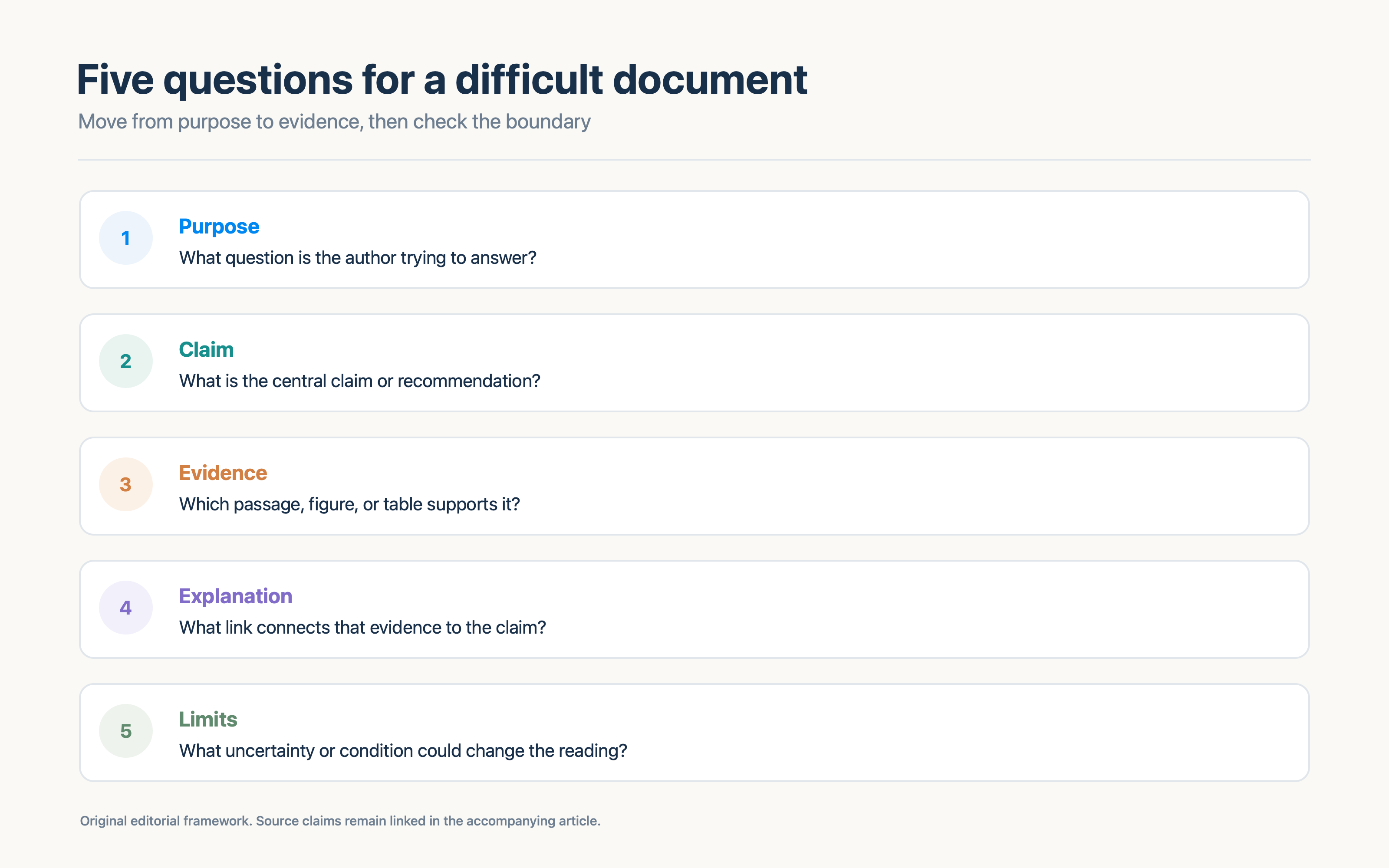
Then move through a small sequence: identify the source's point, locate supporting evidence, explain the relationship, and check what is still uncertain. The questions below are prompts. Pick the ones that fit the source rather than treating them as a quiz you have to finish.
Questions for a difficult document
1. What question is the author trying to answer?
Look at the title, introduction, executive summary, or first section. Rewrite the stated purpose without copying the full sentence. If you cannot find a clear purpose, record what you think the document is trying to establish and mark it as your interpretation.
2. What is the central claim or recommendation?
Separate the main point from background and supporting detail. A report can describe a situation, explain a cause, compare choices, and recommend an action. Those are related claims, but each needs its own evidence.
3. Which part of the source supports the claim?
Save a page, section heading, paragraph, table, or figure. A citation such as “the report says so” does not help you check the claim later. Keep the source location beside the note you write.
4. What does the evidence show directly?
Read the passage closely. Does it report an observation, a measurement, an example, a quotation, a model, or an author's interpretation? Name the kind of support before deciding what it proves.
5. What link connects the evidence to the claim?
This is often the hardest part. Ask the author’s implied “because what?” question. A sentence may support a narrower claim than the paragraph around it. If the relationship is not explicit, state the missing step.
6. What would I explain without looking?
Close the document and describe the point in one or two plain sentences. Then reopen it to check the details. A mismatch tells you what to revisit. This is a retrieval check, not a score of your intelligence.
7. What is assumed, uncertain, or outside scope?
Look for terms that are not defined, groups that were not studied, conditions that limit a result, and alternatives the author does not compare. A limit is not a reason to dismiss the source. It marks the boundary of the conclusion you can draw.
8. What question would change my interpretation?
Try a counterexample, a different context, a missing comparison, or a condition that would reverse the recommendation. If the answer is already in the source, locate it. If not, add it to your next-reading list.
9. What is my next useful step?
Choose an action that matches your need: read the methods, compare another source, ask a subject expert, export the note, or stop. A question list is useful when it helps you decide what deserves attention next.
Why explanation and retrieval deserve a place
These questions combine two different kinds of work. Explaining asks you to connect a point to what you already know. Retrieving asks you to reconstruct it without looking. Research gives reasons to use both carefully.
In a study of eighth-grade students reading a passage about the circulatory system, Chi and colleagues asked one group to explain ideas after reading each line; a comparison group reread the text. The prompted group had a greater pretest-to-posttest gain. The result is from a small study with one passage and should not be generalized to every reader or document. Chi et al., 1994
Karpicke and Blunt compared retrieval practice with elaborative studying using concept maps. Their results reported greater meaningful-learning gains with retrieval practice across science texts, including tests requiring comprehension and inference. That finding supports adding a recall prompt to a reading session. It does not mean that recall replaces close reading or source checking. Karpicke and Blunt, 2011
The exact question set on this page is an editorial tool. The studies above support specific learning activities, not this complete sequence as a tested intervention.
Match the question to the document
For a research paper, check the research question, sample, method, outcome, and limitation. For a strategy memo, ask which option the author recommends, what evidence supports it, and what conditions would change the choice. For a policy document, locate the rule, the group it covers, the effective date, and the exception process.
For a long document, do not try to attach a question to every paragraph. Start with the sections that could change your decision or understanding. If the source has an abstract, contents page, headings, table of contents, or executive summary, use those as a map. Return to the full passage before recording a conclusion.
Example: check one recommendation
Imagine a report recommends expanding a service. First ask what problem the recommendation addresses. Then find the evidence the report uses, such as a user study, operating limit, cost estimate, or comparison. Ask whether that evidence covers the same group and time period as the recommendation. Explain the connection in your own words, then name one condition that could change your view. If the report does not answer the last question, leave it open. This small sequence keeps the reading focused and makes the gap visible.
A simple note format
Use four lines for a point you want to keep:
- Question: What do I need to know?
- Source location: Where is the relevant evidence?
- Answer: What does the source say, in my own words?
- Check: What is uncertain or worth comparing?
For example, when reading a paper about retrieval practice, a note could ask how the authors compared retrieval with concept mapping. The answer should name the comparison as the paper reports it. The check might remind you to inspect the methods before claiming the same result for a different subject.
If a tool drafts an answer, use the same format. Keep its wording separate until you have checked the location in the document. A fluent sentence without a source anchor is still an unverified note.
Use the questions in Recap Learning
Recap starts by creating a structured Recap Document from a source. Its Learning next step provides question cards grouped by perspectives and organizes selected answers in a mind-map view. A question can give you a useful starting point, while your source remains the place to check the claim and its limits.
Try one card that fits your current need. Read the answer, then ask: Which part came from the source? Which part is interpretation? What would I need to verify before acting on it? If the response does not answer your real question, choose another card or write down a follow-up question.
Recap's Source to PBL Learning tool supports question-led exploration. See the original question ladder for a source-to-reflection sequence, or start with a structured document before selecting a next step. For a related look at how questioning frameworks organize kinds of thinking, read the guide to educational taxonomies.
Continue in Recap
Turn this source into a Recap Document
Make it easier to read, then send time-based details to Calendar, export it to Workspace, or start PBL Learning.