

A statement can be accurate within its source and still be too broad for the decision you need to make. A survey of volunteers may describe their responses but not every customer. A notice may offer a benefit only in one district. A metric labeled "visits" may count appointments rather than people. The missing work is to keep the claim attached to its boundaries.
Use the worksheet below when a report, notice, chart or article contains a claim you want to act on or share. It separates what the source says from your interpretation, your decision and the information you have not found. Two fictional examples show how the same worksheet works for a service notice and a survey result.
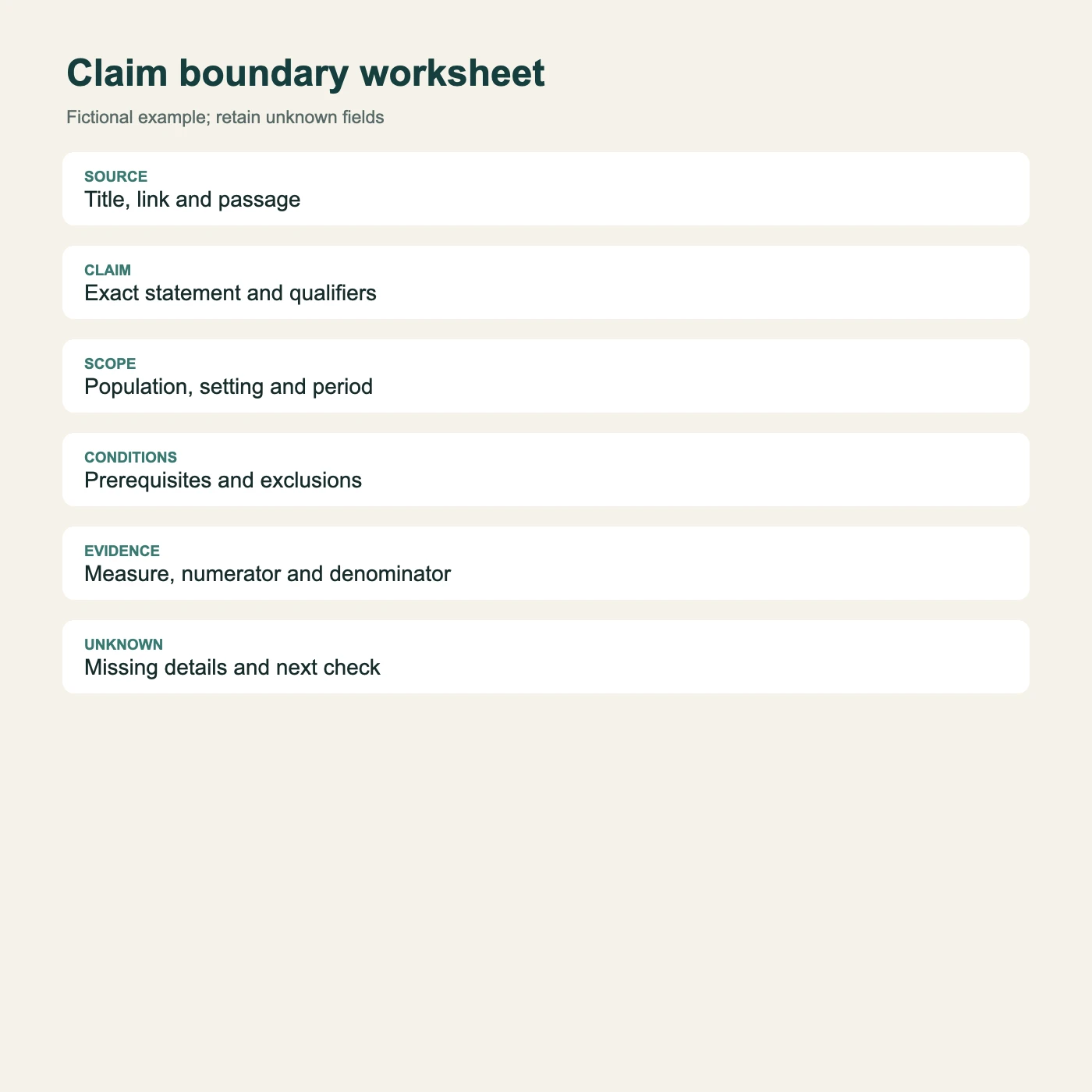
The worksheet
Copy one claim at a time. If a paragraph makes two claims with different groups or conditions, make two records.
| Field | What to record |
|---|---|
| Source and location | Title, publisher, link and the page, table, paragraph or timestamp containing the claim |
| Claim as stated | The relevant passage or a faithful paraphrase with its qualifiers |
| Population and setting | People, items, place and period the claim describes |
| Conditions and exclusions | Eligibility, prerequisites, exceptions and limits stated in the source |
| Measurement or evidence | What was counted or observed; numerator, denominator and unit when applicable |
| Missing or unclear | Details not found after checking the source; distinguish an excerpt from the full source |
| Your interpretation | What you think the evidence may mean, labeled as interpretation |
| Your decision | The action you are considering and who must make it |
| Next check | A source, question or comparison that could resolve an important gap |
A complete row can contain "not stated." The worksheet is not a way to manufacture missing facts. It is a record of what a reader can trace and what remains open.
First, preserve the claim and its location
Copy enough surrounding context to retain the subject and qualifier. A number by itself can lose its denominator; a sentence separated from the preceding paragraph can lose the group it describes. Record the table or page as well as the link so another reader can find it.
If you are reading a summary of another report, distinguish the summary from the original. Follow the original when possible and check whether the same claim, group and limitations appear there. The MIT Libraries guide to evaluating information recommends examining a source's relevance and whether it reports original research. That guidance helps locate evidence; it does not guarantee that every original study is suitable for your decision.
Do not assume a polished chart answers every question. Its caption, footnotes, methods and underlying table may define what is counted. Record which part you checked. "Not stated in the excerpt" and "not found in the full report" are different observations.
Identify who and what the claim describes
Look for a named population, a location and a time period. A survey may aim to describe all adults in an area while receiving answers from a smaller group selected through a particular method. A notice may apply to residents of a district rather than an entire city. A metric may count events rather than distinct people.
The U.S. Census Bureau's response-rate definitions distinguish eligible sampled units from units where the minimum required information was not obtained. This is a reminder to look separately for the intended group, recruitment or sampling, and respondents. Those Census definitions belong to that survey; use the method of the source you are actually reviewing.
For your decision, write a second description of the people and setting involved. Do not silently replace the source's group with your own. If they differ, ask whether the source offers evidence that the result applies across that difference. If it does not, record the gap.
Find conditions, exceptions and dates
Look for who qualifies, what must happen first and what is excluded. A source may specify a deadline, minimum amount, location, age range, prior action or limited period. These can be distributed across a headline, a linked policy and a footnote.
A date requires enough context to use it. "Through June 30" without a year does not establish whether an offer is active today. If a linked eligibility page is unavailable, the correct record is that you could not review it. The missing page is not evidence that there are no additional rules.
The same principle applies to research. Question wording and order can affect survey responses, as Pew Research Center explains in its survey-question guidance. A result about support for a proposal should retain any stated cost, tradeoff or scenario in the question. Those details help define what respondents were answering.
Record what the number measures
For a percentage, identify the part and the whole. The CDC's vital-statistics training manual describes a percentage as a proportion and notes the importance of the denominator. A claim of 60% does not reveal whether the base was five people, a thousand people or a weighted estimate. Different counts can produce the same percentage.
For a rate or operational metric, identify the unit and period too. "Visits" might mean check-ins, phone calls or distinct people depending on the source. NIST's discussion of measurement uncertainty emphasizes the property being measured and the uncertainty associated with a result. Everyday operational metrics are not necessarily formal metrology, but naming the counted event remains essential to interpretation.
If a method changed between periods, a difference in the reported number may not describe a change in the underlying activity alone. Look for documented changes in collection, eligibility, definitions or time window. Do not assert that a change occurred without evidence; list it as a question if the report does not say.
Worked example 1: a repair-kit notice
The following passage is fictional and created for this worksheet:
Residents of the North District may borrow a repair kit free for seven days if they register with the community center. The offer runs through June 30. Kits must be collected during staffed hours; replacement parts are not included.
Source and location: This synthetic passage; no real offer is being advertised.
Claim: North District residents may borrow a kit free for seven days after registering.
Population and setting: Residents of the named district, using the community center's offer. The passage gives no address.
Conditions and exclusions: Registration and collection during staffed hours are stated. Replacement parts are excluded. The end date is June 30, with no year given.
Measurement or evidence: This is a notice of terms, not a survey or numerical outcome. The seven days describe the loan period, not the duration of the offer.
Missing or unclear: The year, staffed hours, registration method, stock and proof of residence are not stated. The passage does not say whether a kit is currently available.
Interpretation: A reader living in the named district might be eligible if the offer remains active and any additional requirements are met. That is conditional interpretation, not confirmation from the center.
Decision: A resident decides whether to contact the center before making a trip. A different organization deciding whether to launch a similar service would need its own cost, demand and staffing information.
Next check: Find the current official notice or ask the center for the year, hours, registration procedure and availability. Record the answer and date separately from the fictional passage.
A concise shareable version would retain the conditions: "The notice describes a seven-day loan for North District residents who register; parts are excluded. It gives June 30 without a year, so current availability is unknown." That is more useful than repeating "free kits for everyone."
Worked example 2: a local survey result
This separate example is also fictional:
The library invited followers of its social account to choose an event day. Of 80 people who answered, 60 chose Saturday. The survey was open for one week.
Source and location: This synthetic passage; it is not a real library poll.
Claim: Sixty of 80 respondents chose Saturday. That is 75% of the stated respondents.
Population and setting: People reached by the library's social account who chose to answer during that week. The passage does not establish whether each respondent used the library or lived nearby.
Conditions and exclusions: The invitation used one channel. The passage does not say whether multiple selections were allowed, so the exact interpretation of "chose" remains limited.
Measurement or evidence: The stated numerator is 60 respondents choosing Saturday; the denominator is 80 respondents. The passage does not provide a response rate because it does not say how many people saw the invitation.
Missing or unclear: Invitation reach, exact wording, alternative days, duplicate controls and characteristics of nonrespondents are not stated.
Interpretation: Saturday was chosen by three quarters of the people recorded in this fictional response set. Whether that proportion reflects all library users or local residents is unknown.
Decision: Library staff decide whether to schedule an event. They may use the result as one input while considering other evidence, such as a separate survey reaching visitors who do not use the social account.
Next check: Locate the questionnaire and distribution record; ask how the invitation was shown and whether the result is weighted. If the decision requires a broader estimate, consider a method designed for that population.
The calculation is straightforward, but the generalization is not. Eighty responses can be accurately counted without establishing the preferences of everyone in the community. The size and direction of any difference between respondents and nonrespondents are not established by the passage.
Decide what the evidence can do
After filling the worksheet, choose a description that fits the source. A claim might be sufficient to explain a specific notice, useful as background for a test, or too incomplete to support the action. The appropriate threshold depends on the decision and the cost of being wrong. The worksheet does not turn a missing denominator into a reliable estimate or replace expert advice for a specialized decision.
When comparing sources, create a separate record for each before combining them. Two reports can use the same label for different measures. Check their populations, definitions, time windows and methods before treating the numbers as comparable. A later source is not automatically a correction of an earlier one; it may describe a different period or question.
If a source does not support a conclusion you hoped to draw, keep the useful part. For example, a small voluntary poll can show what those respondents chose and suggest a question for a broader investigation. It cannot tell you the preferences of nonrespondents without additional evidence.
Keep the original available during review
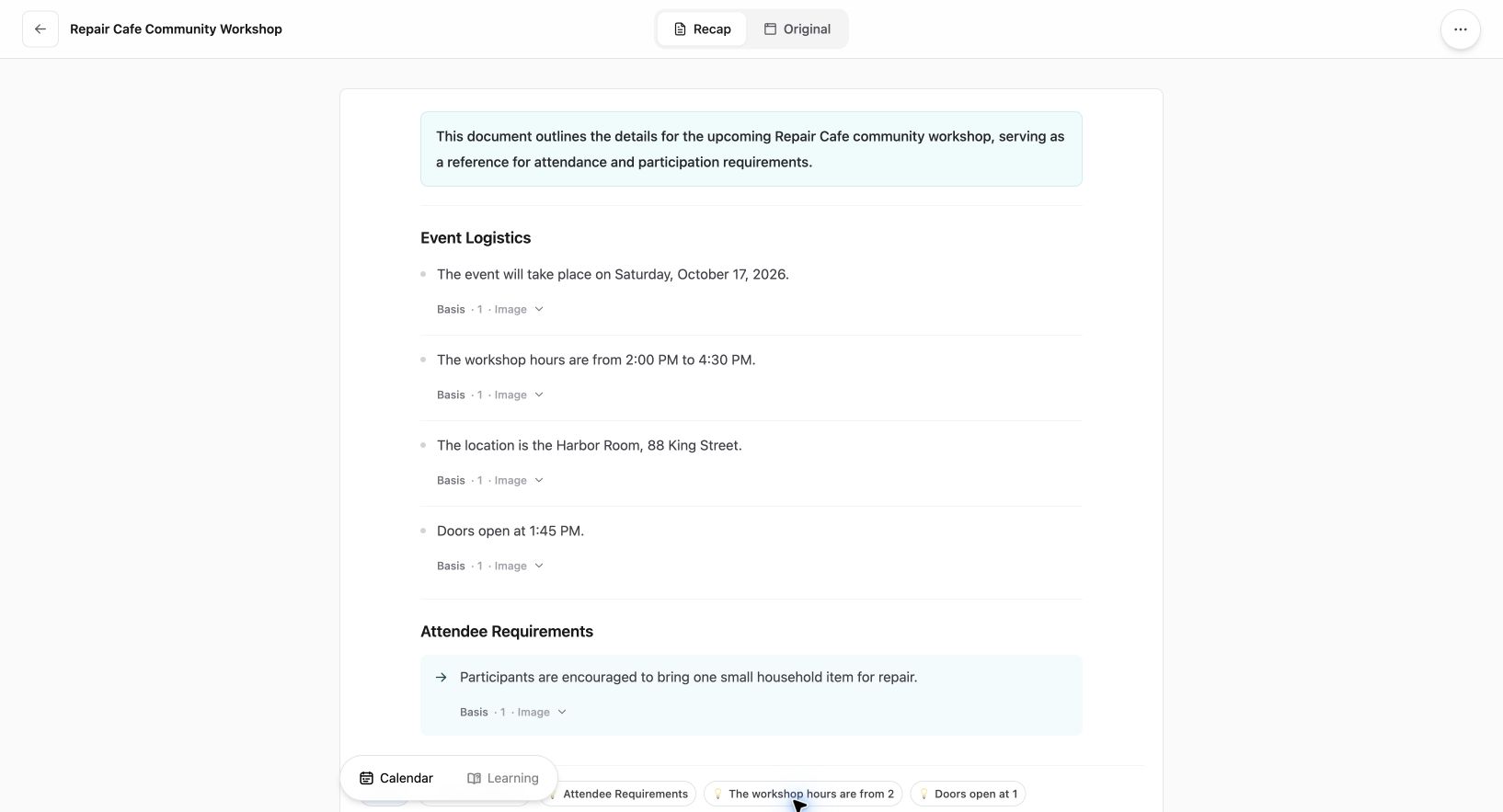
This screenshot shows a separate synthetic event flyer in Recap Web, not either fictional example above. It was captured on November 16 and the same document and basis controls were checked again on November 23.
A structured source document can make a long source easier to navigate. Compare the resulting wording, numbers and qualifiers with the original before relying on them. The source-grounded document checklist provides another way to retain source locations, and What is a Recap Document? explains the document as the foundation for reviewing a source.
For a source worth exploring further, source-to-PBL Learning describes an optional question-led next step. The choice to investigate further does not resolve a missing fact by itself. Return to the original passage or another appropriate source when the answer matters.
The completed worksheet should make it possible for another reader to locate the claim, see the boundary and understand the decision still to be made. If a field remains blank because the source does not answer it, leave that uncertainty in the record.
Continue in Recap
Turn this source into a Recap Document
Make it easier to read, then send time-based details to Calendar or start PBL Learning.