

A statement can be accurate only under conditions that disappear when it is repeated. "The offer covers delivery" becomes misleading if the original says delivery is included only for orders above a threshold within a specified area. Before acting on a claim, find the words that set its boundaries and keep them beside the result.
The same review applies to a policy, research finding, product notice or event announcement. Conditions may appear in the sentence itself, in a footnote, in eligibility rules or in a separate methods section. An absent condition should remain unknown; it should not be inferred from an attractive headline.
Work from one passage
Consider this fictional notice:
Residents of the North District may borrow a repair kit free for seven days if they register with the community center. The offer runs through June 30. Kits must be collected during staffed hours; replacement parts are not included.
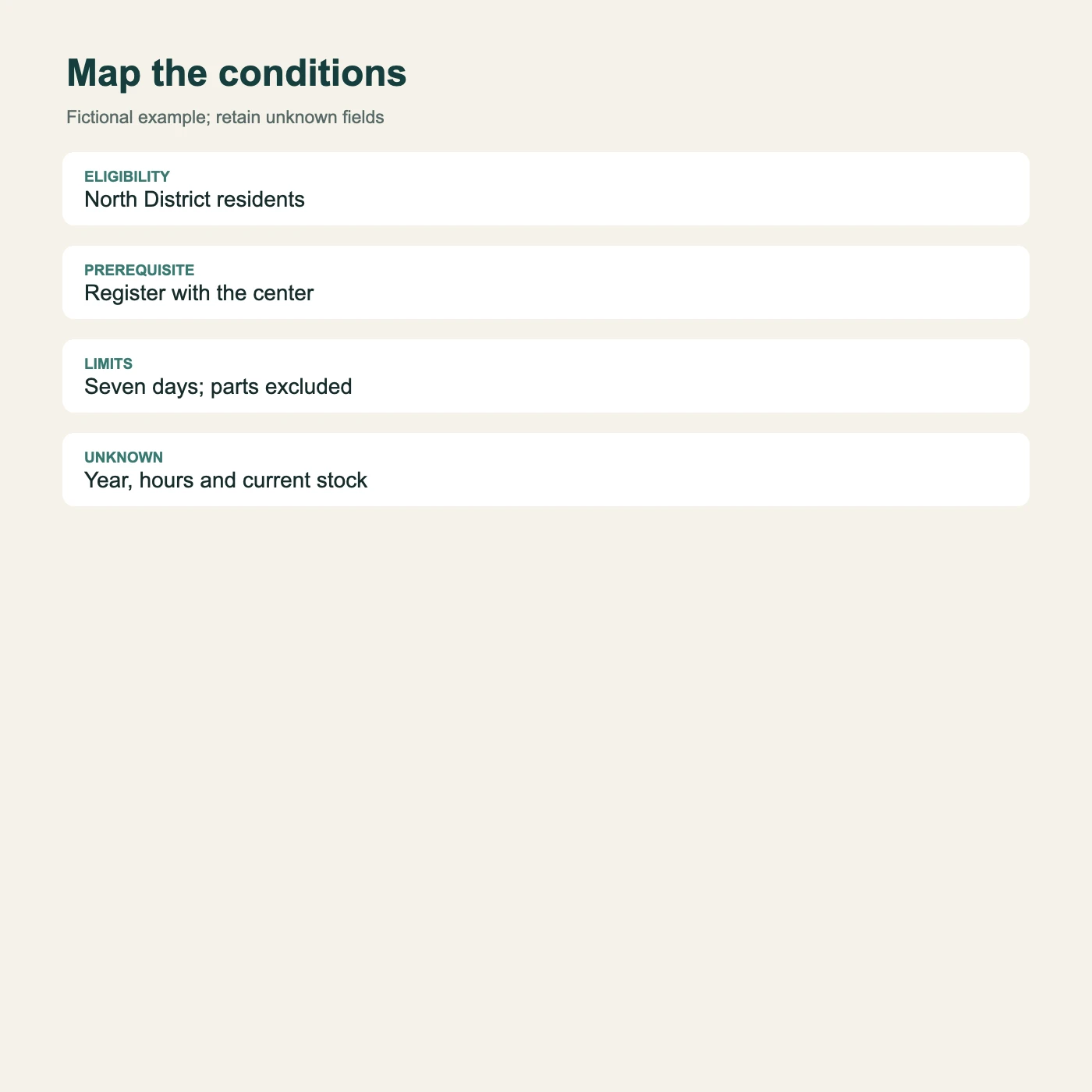
The headline "Free repair kits for residents" would omit several details a reader needs. The stated group is North District residents, registration is required, the loan lasts seven days, the offer ends June 30, collection happens during staffed hours and replacement parts are excluded. The notice does not specify a year, an address, proof of residence or whether kits are available at the moment a person arrives.
Those missing details are not evidence that the offer has no requirements on those topics. They are questions for the center or for a fuller version of the notice. In particular, a date without a year cannot establish whether the offer is current.
| Part of the notice | How to record it | What not to infer |
|---|---|---|
| North District residents | Eligibility named by the notice | Eligibility for every resident of the city |
| Register with the center | Stated prerequisite | That registration is available online |
| Seven-day loan | Stated loan duration | That ownership transfers to the borrower |
| Through June 30 | Stated end date, year missing | That the offer is currently active |
| Parts not included | Explicit exclusion | That tools or assistance are also excluded |
Separate eligibility from the action
First identify who or what the claim concerns. Next identify the action or benefit. A reader who is eligible still may need to register, provide information, meet a deadline or act in a particular location. Conversely, a process instruction does not by itself prove that every reader is eligible.
For the fictional repair kit, "resident" is not enough to establish eligibility: the notice names a district. Registration is a prerequisite, not a promise that a kit will be available. The notice does not say what happens if demand exceeds supply, so the safe record is "availability not stated."
This way of reading is useful beyond offers. A research report may describe a result among adults who met specific criteria during a study period. Those criteria and the measurement conditions belong with the finding. NIST's explanation of measurement uncertainty describes a measurement as a result associated with a defined property and incomplete knowledge about its value. A result without its definition or conditions can be difficult to apply to a different question.
Look for exceptions and limits in context
Words such as "unless," "only," "except," "during" and "subject to" can point to boundaries, but the absence of these words does not mean none exist. Check the complete paragraph and nearby notes. In a table, read the caption and footnotes. For a survey result, inspect the question, response options and method rather than treating the headline as the full source.
Pew Research Center's account of survey-question writing explains that wording and question order can affect responses. If a result is described as support for a proposal, read whether the question included a price, a tradeoff or a particular scenario. Those details are part of what was measured.
When a source links to a separate eligibility page, follow it if available. Record the page and the date you checked it because a linked policy can change. If the link fails or the page is missing, do not say the conditions were satisfied; say the linked conditions could not be reviewed.
Map a passage into four fields
Use a short record that another reader can check against the original:
- Claim: What does the source say happens, and to whom?
- Prerequisites: What must be true or done before it applies?
- Exceptions and limits: What is excluded, capped, restricted by place or limited in time?
- Open questions: What is missing from the source or unclear for this decision?
For the repair kit, the claim is a free seven-day loan for eligible residents. Registration is the prerequisite. Staffed collection hours, the end date and excluded parts are limits. The missing year and address are open questions. Each entry is traceable to the short passage, except the questions, which are clearly marked as missing.
Avoid turning an open question into an assumption. "The center probably opens on weekends" would change a practical decision, yet the passage says only "staffed hours." If a person cannot collect a kit on weekdays, the hours may determine whether the offer is usable.
Check whether a condition fits your case
After recording the source, describe your own situation separately. A reader might know they live in the North District, but that does not establish that registration is open or that a kit is in stock. A library considering a similar program might find the notice useful as an example, but it cannot infer the center's budget or results from it.
This distinction prevents a common shortcut: using a true statement about one set of circumstances as a promise about another. For an important decision, contact the source owner or locate an official current page for the unresolved detail. Keep the response with the date and channel rather than silently changing the original passage.
Preserve the condition when sharing
A useful short version of the fictional notice is: "North District residents can register for a seven-day repair-kit loan; collection is during staffed hours and parts are excluded. The notice says June 30 but does not give a year." It is longer than the stripped headline, but the details change what a reader can do.
The source claim boundary worksheet offers a place to keep prerequisites and exceptions beside a claim. The source-grounded document checklist helps preserve source locations. A structured source document can make a long notice easier to review, provided the final record is checked against the original and unknowns remain visible.
Continue in Recap
Turn this source into a Recap Document
Make it easier to read, then send time-based details to Calendar or start PBL Learning.