

A source can describe a real result accurately and still leave an important question unanswered: does it apply to the people in front of you? A finding about volunteers at one location is evidence about that setting. Applying it to another group requires a separate judgment about who was studied, how they were selected and what differs in the new setting.
You do not need to be a statistician to keep those distinctions visible. Start with the source's own description of its population, then compare it with the decision you need to make. Where the source is silent, leave a question rather than supplying an answer.
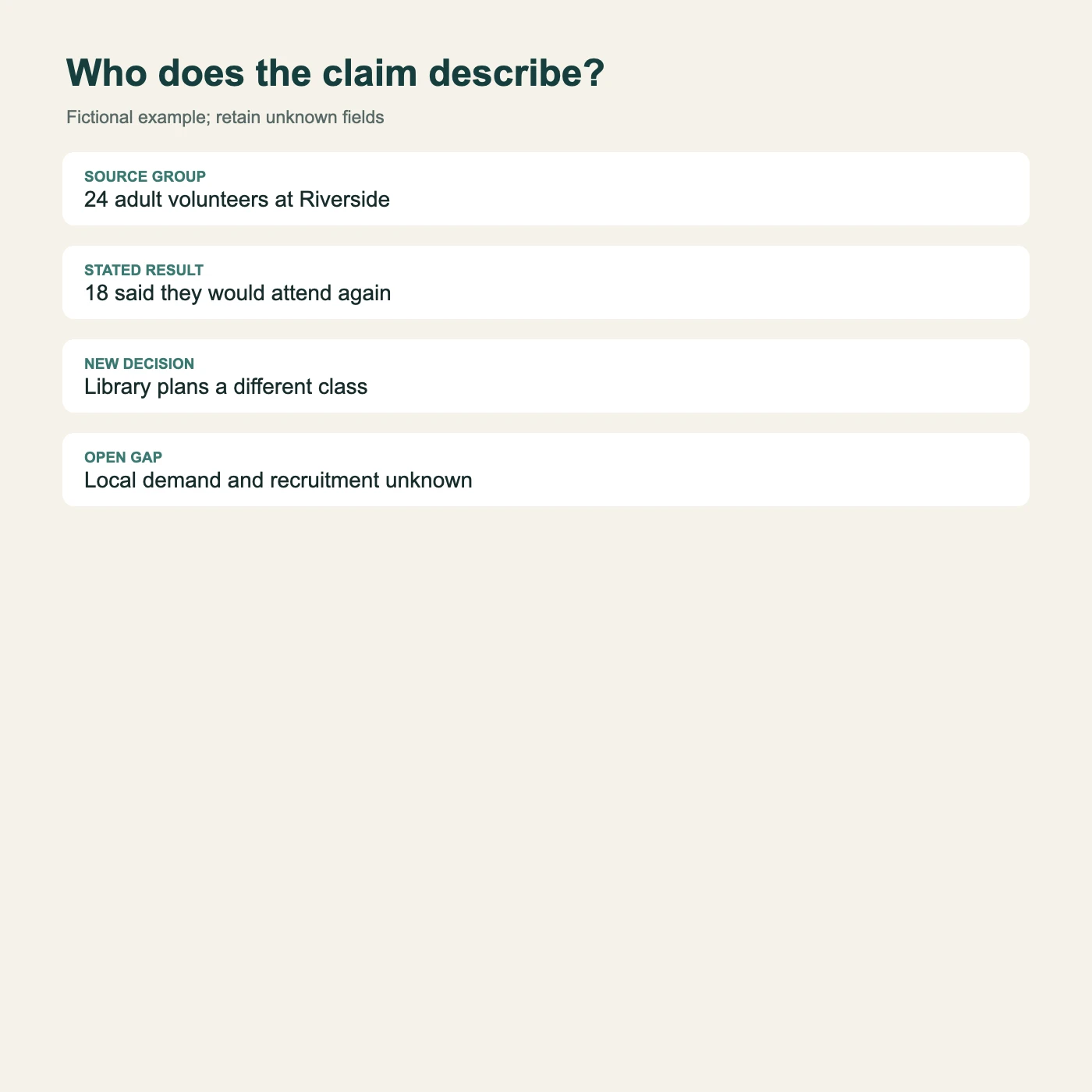
A claim and a decision are different records
Imagine this fictional notice:
In a spring trial at the Riverside community center, 24 adults volunteered to test an evening class. Eighteen said they would attend again.
The source describes 24 adult volunteers at one community center. Eighteen of those 24 said they would attend again: 75% of the volunteers in this fictional example. The notice does not say how the volunteers heard about the trial, what the class cost, whether the response was anonymous or how long after the class they were asked.
Now imagine a library in another neighborhood deciding whether to offer an evening class. The volunteers' responses may suggest a question worth asking locally. They do not establish that 75% of the library's visitors, or of all adults in the neighborhood, would attend. The library serves a different group and may offer a different class at a different time or price. The source gives no evidence about those differences.
| Question | Stated in fictional source | Needed for the library decision |
|---|---|---|
| Who responded? | 24 adult volunteers | Which library users could attend? |
| Where and when? | Riverside center, spring | The library's location and proposed dates |
| What was asked? | Whether they would attend again | Whether a new group would attend a proposed class |
| What is missing? | Recruitment, price and exact question wording | Local demand, constraints and alternatives |
The table does not show a flaw in the arithmetic. It shows the distance between the reported result and the decision. A larger sample alone would not answer whether the class and the population are comparable.
Find the population the source names
Look for the people, organizations, events or items counted in the original report. A headline may say "people" where the method says "respondents who opted in," "adults in one country" or "customers who completed a purchase." Preserve those qualifications when you restate the claim.
Population and respondents are related but not identical. A survey may aim to describe all adults in a region, draw a sample from a list and receive answers from only some of those selected. In the American Community Survey response-rate definitions, the U.S. Census Bureau distinguishes sampled eligible units from cases where the required information was not obtained. Those distinctions affect what the result can support.
Look for four descriptions: the intended population, the sampling frame or recruitment path, the people who actually responded and the group used in the specific result. If the source only provides one of these, write down which one it is. A chart showing answers to an optional question may have a different base from the full survey.
Separate what was measured from what you want to know
The fictional volunteers were asked whether they would attend again. That is a reported intention from people who had already tried the class. The library wants to know whether a broader group would attend a different class. Attendance, intention, prior participation and awareness are different things.
Question wording can change what a response means. Pew Research Center's guidance on writing survey questions explains why wording and the order of questions matter, and describes testing questions before fielding them. Whenever possible, read the actual question and the available answer options. A summary that says "support" may conceal what respondents were asked to support and under which conditions.
Time matters too. A result about a trial last spring does not automatically describe preferences today. Find the dates when data were collected, not just the publication date. The interval is especially relevant when the service, prices, population or policy has changed.
Compare settings without inventing a rule
You can use a simple comparison before making the decision:
- Copy the claim with its named group and setting.
- Describe the group and setting for your decision in equally concrete terms.
- List differences the source does not resolve, such as eligibility, geography, time, cost or prior experience.
- Decide whether the claim is background, a reason to investigate, or sufficient evidence for the specific action.
- Record what additional information could change that decision.
Not every difference makes a source irrelevant. A detailed study from another setting may still explain a mechanism or suggest options to test. The issue is whether the source gives a reason to expect the result to carry over. If you cannot tell, say so and keep the decision proportionate to that uncertainty.
Read recruitment and nonresponse together
A source may identify its intended population but offer little detail about who chose to respond. Volunteers can differ from people who did not volunteer, although the direction and size of any difference are not established merely by the word "volunteer." Likewise, nonresponse can introduce bias when respondents and nonrespondents differ in ways relevant to the result; the Census Bureau's definitions explain the risk without treating every nonresponse as proof of a particular error.
Some surveys use weighting and other adjustments. Those methods are useful to inspect, but they do not license a reader to assume every possible difference has been corrected. Read the method and any stated limitations. If the report gives a margin of error, check what it covers; it should not be treated as a complete accounting of every possible survey error.
Keep the gap attached to the claim
A compact record could read: "At Riverside, 18 of 24 adult volunteers said they would attend again. The notice does not describe recruitment or class price. Applicability to library visitors is unknown." That sentence retains the evidence and the missing information without dismissing either.
Use the source claim boundary worksheet when a decision depends on several such qualifiers. The source-grounded document checklist can help keep passages linked to their context. If you start with a structured source document, compare its group labels and numbers with the original before sharing the conclusion.
Continue in Recap
Turn this source into a Recap Document
Make it easier to read, then send time-based details to Calendar or start PBL Learning.