

A product review becomes a decision brief when its claims are mapped to your actual requirements. Keep the reviewer's results, the manufacturer's specifications, and your own preferences in separate fields. A detailed review may still leave the question that matters to you unanswered.
This guide uses a manufacturer's published benchmark article and specification as public reading material. The buyer scenario is fictional. No hardware was tested for this guide, and the exercise does not recommend buying the product or claim that Recap reproduced the analysis automatically.
State the buyer's question before reading the verdict
Our fictional reader is considering a small computer for a meeting-room display. They need to connect two screens, use an existing installation, and avoid distracting noise. Those criteria describe this reader's circumstances. They are not general requirements for everyone buying a computer.
Write the question as “What evidence would justify testing this device in our installation?” This is different from asking which product has the highest review score. The first question can be answered cautiously from incomplete evidence. The second invites a comparison you may not have enough material to make.
Record which requirements are mandatory. If the installation needs two outputs, that is a gate. A preference for a certain appearance may be negotiable. Do not assign numerical weights until everyone using the brief understands what the scale means. A five-point score cannot repair an unknown requirement.
Identify what kind of review you have
Raspberry Pi's benchmark article is published by the manufacturer. Treat it as first-party test reporting, with the publisher's commercial interest visible. It is not an independent consumer review.
Save the title, author if shown, publication date, and the part of the article you are using. Record the tested workload and configuration wherever a result depends on them. If the article does not supply a detail needed for your use case, mark it missing. Do not invent a test environment because another benchmark usually uses one.
A reviewer's positive description may be useful context, but it has a different status from a measured result. “Pleasant to use” describes the writer's experience. A reported timing describes a particular test. Neither statement establishes that your meeting-room installation will behave the same way.
Cross-check a specific claim
The current Raspberry Pi 5 specification lists dual 4Kp60 HDMI output. That supports recording the stated output capability. It does not prove compatibility with the fictional buyer's particular screens, cabling, software, enclosure, or operating conditions.
Use the manufacturer's page as a separate cross-check. Keep its URL and access date beside the claim. Do not silently combine the review and specification into a single purported source. When processing material in Recap, handle each source on its own and compare the reviewed records yourself.
If two sources disagree, preserve both statements with their dates. Check whether they concern different models, software versions, or test conditions. A source conflict should produce a question for investigation rather than an average of incompatible claims.
Build a claim-to-criterion record
A useful record has enough context to show where the evidence stops.
| Entry | Evidence type | Meaning for this buyer |
|---|---|---|
| Stated display capability | Manufacturer specification | A reason to investigate the two-screen requirement |
| Reported benchmark result | Manufacturer's test article | Evidence about its reported test conditions |
| Quiet meeting-room operation | Buyer criterion | Unresolved without evidence about the complete setup |
| Compatibility with existing installation | Buyer criterion | Requires checking the actual components |
| Approval to purchase | Decision | Not established by the available source material |
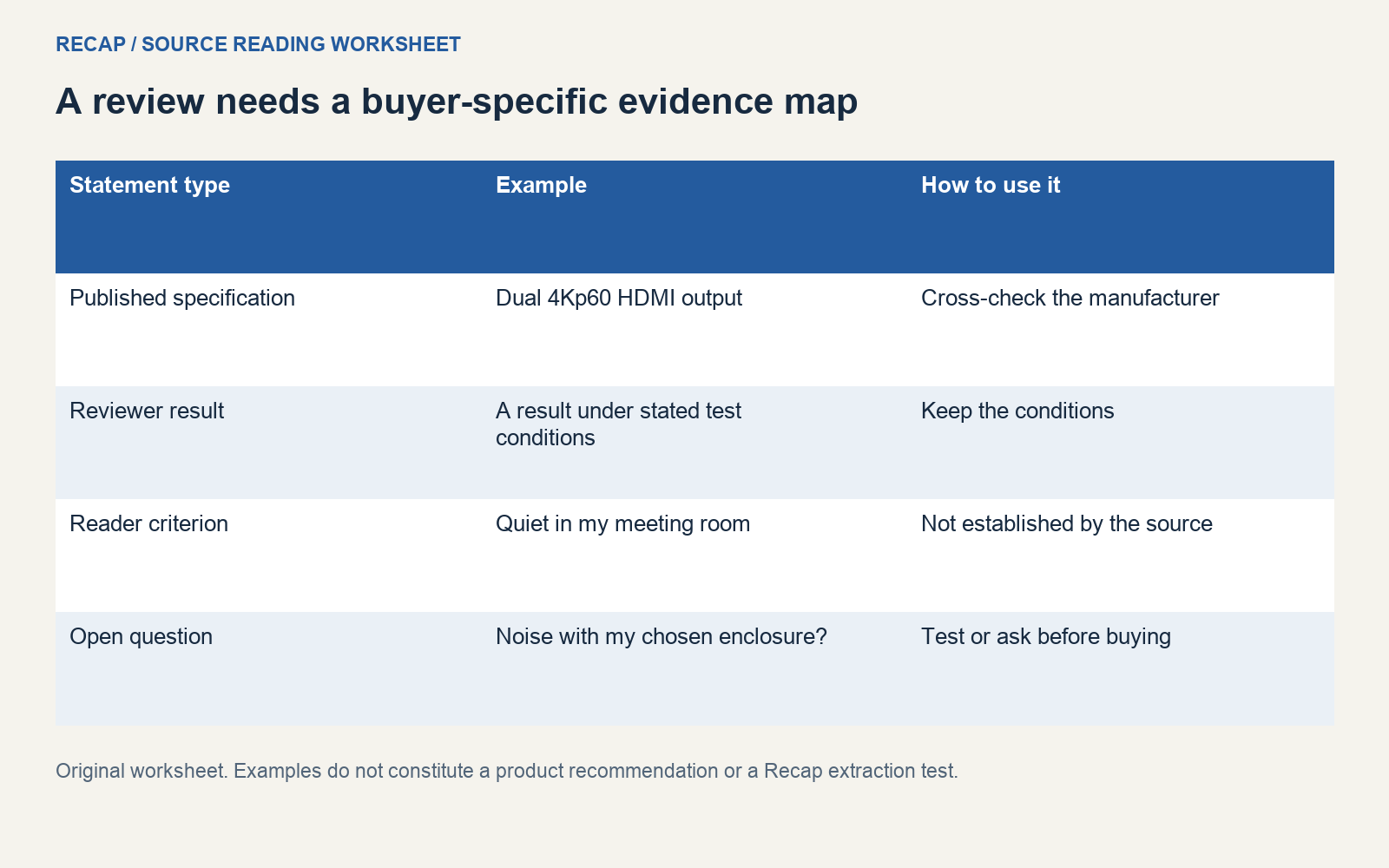
The empty compatibility field is valuable. It prevents a technical capability from being retold as a completed installation test. Keep the unknown visible when the brief leaves your own notes and enters a team discussion.
Preserve conditions around measured claims
Before reusing any benchmark, ask what was measured and what the comparison actually holds constant. A faster result for one workload does not establish a faster result for every workload. A result from an open test setup does not describe the noise or temperature of a finished installation.
Copy only the smallest relevant result, with the conditions needed to interpret it. If you cannot recover the units, comparison baseline, or test configuration, keep the result out of the decision table until you can. A number without those details can look more persuasive than the evidence warrants.
Also distinguish a missing measurement from a poor measurement. If the source does not test noise, it provides no answer to your noise question. It does not establish that the product is loud, silent, or unsuitable. Record “not established here” rather than converting absence into a negative finding.
Write a recommendation with a bounded scope
For this fictional buyer, a defensible next step is to define a small compatibility test. The brief can name the actual screens, enclosure, required software, and the people who will judge acceptable operation. It should leave those values blank until someone supplies them.
That next step is the reader's proposal. The manufacturer did not instruct this buyer to run it, and the review did not promise a successful result. The proposal can still be useful when its origin is clear.
Avoid writing “buy” just to make the brief feel decisive. “Investigate display and enclosure compatibility before ordering” is a complete decision status. It explains why the process has stopped and what could move it forward.
If a purchase also depends on current price or availability, obtain fresh supplier evidence separately. This guide intentionally does not reuse the historical launch prices in old articles. A dated review cannot establish the checkout total for your region today.
Keep the brief usable after the conversation
Use short locators for each claim. “Specification, display output” is easier to check than a bare product-page URL. For a long review, add the section heading or test name. Date your brief so another reader can distinguish the current specification from the version used in an earlier decision.
When a requirement changes, revise the criterion and explain who changed it. Do not retroactively alter a source fact to fit the new requirement. For example, a later decision to use one display changes the buyer's gate; it does not change the stated hardware capability.
Recap creates a structured readable document from a source, with Calendar, Workspace, and Learning available as parallel next steps. This guide's evaluation worksheet is a manual review method, not a promise of a particular generated layout. Use the structured-document entry point to start from your material.
The single-source decision brief provides the larger template. If the saved review is still only a compressed retelling, the structured notes and summary comparison explains what a reusable record needs. Keep your next investigation attached to the requirement it is meant to resolve.
Continue in Recap
Turn this source into a Recap Document
Make it easier to read, then send time-based details to Calendar, export it to Workspace, or start PBL Learning.