

A policy or service-change notice becomes an action brief when you preserve its scope, dates, and stated requirements, then separate your own follow-up work from the publisher's instructions. A clear brief should also say when the notice does not establish whether you are affected.
This guide uses a dated software-platform notice as a historical reading exercise. It is not a current migration alert, legal advice, or a claim that Recap performed a migration. The example's internal investigation questions are reader proposals.
Identify the notice and its time frame
Our source is GitHub's September 19, 2025 announcement about retiring the macOS 13 runner image. It identifies affected runner labels, describes scheduled interruptions, and gives December 4, 2025 as the announced retirement date.
That date is in the past when this guide is checked on October 19, 2026. Keep the announcement date and retirement date together. A copied deadline without the year could make an old notice look like a new obligation.
Record the publisher, URL, access date, and relevant heading. If a forwarded message strips away the original date or links, recover those details before turning it into a task. When you cannot establish which version of a notice you have, mark its currency as unresolved.
Do not replace the historical notice with an undated description of present platform support. The notice establishes what GitHub announced at that time. Current supported runner choices require current documentation.
Extract applicability before extracting tasks
The notice names the macOS 13 runner labels. The first question for a reader is whether a workflow actually uses an affected label. Being a GitHub customer does not by itself establish that this particular announcement requires a change to every project.
An applicability record can contain a source field and a local-check field.
| Field | Source-backed entry | Reader investigation |
|---|---|---|
| Affected service | GitHub-hosted macOS 13 runner images | Do our workflows use these images? |
| Named scope | The macOS 13 labels in the notice | Which workflow files reference them? |
| Announced date | Retirement by December 4, 2025 | Treat as historical; inspect the present configuration |
| Replacement choice | Alternatives depend on architecture needs | Which requirements does this project have? |
| Internal owner | Not named by the publisher | Who maintains the affected workflow? |
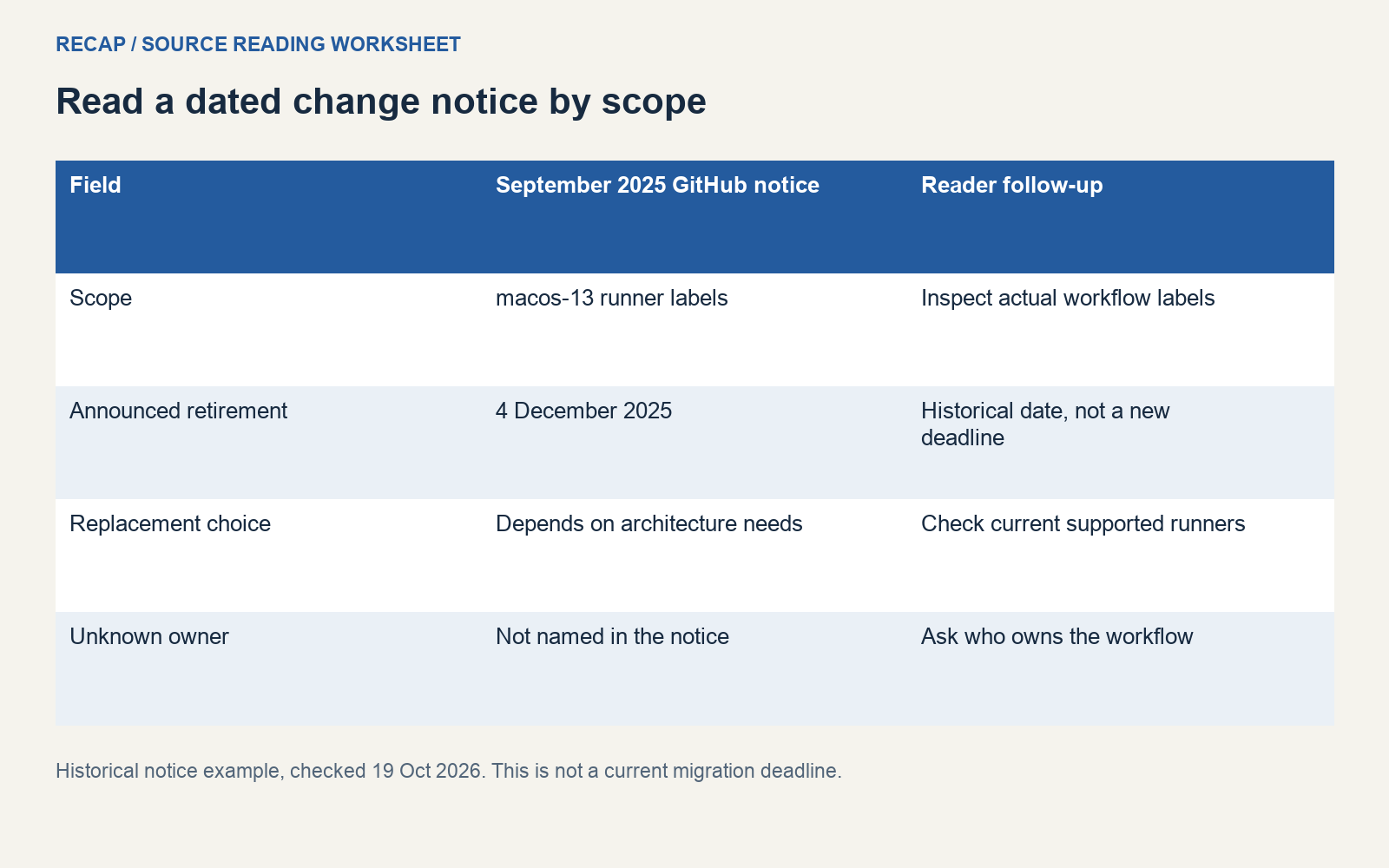
The reader's repository configuration is another source of evidence. Keep it separate from the public announcement. The notice does not prove what a private repository contains, and a public guide should not claim to have inspected a reader's project.
Preserve the strength of each instruction
Read words such as must, recommend, may, and optional carefully. A suggested replacement is different from a requirement that applies to a named service. A date attached to a scheduled interruption is different from a date attached to final retirement.
If you summarize several dated events, give each event a separate row. Avoid turning every date into a final deadline. You may decide that only one date matters for your investigation, but the brief should explain why you selected it.
Keep qualifications beside the instruction. In this example, architecture requirements matter to the replacement choice. Removing that qualification could turn a conditional suggestion into a universal instruction to switch to one label.
The current GitHub-hosted runner reference is the appropriate separate source for checking today's documented runner options. Do not assume that every replacement named in a 2025 announcement is still the best or available choice for a 2026 project.
Turn source instructions into bounded work
A proposed internal action might be “Inspect the workflow configuration for the labels named in the announcement.” That is a reader-created investigation. It is more precise than “Fix GitHub policy,” which hides both the scope and the expected result.
Before changing a workflow, identify the build's actual platform requirements and the intended verification. The public notice does not supply those requirements for you. It cannot confirm whether a dependency supports a particular architecture or whether an internal test covers the relevant behavior.
Write the proposed action with an outcome that can be checked. For example: “Record which affected workflow files exist and who maintains them.” This can be completed without silently authorizing a repository change.
A later migration task should have its own reviewed target and acceptance conditions. Do not treat the act of reading a notice as approval to edit a repository, spend money, accept new terms, or change an account.
Keep unresolved applicability visible
Sometimes the notice says exactly what changes, but you cannot tell whether your environment uses it. Record “applicability not yet established.” That is different from unaffected and different from confirmed affected.
List the evidence needed to resolve it. For this example, the evidence might be the relevant workflow file and the owner's explanation of architecture constraints. If someone supplies only a verbal assurance, record that as a dated statement rather than replacing the configuration field with a verified result.
Also distinguish the source publisher from the internal decision-maker. GitHub can define its hosted-runner support. It does not name your team's owner or authorize a specific change window. Those decisions need local authority.
If the notice has been superseded, retain its identity and link to the newer source separately. A future reader should be able to see why the first brief was revised.
Review the action brief before using it
Read the brief without the original open. Can you tell which service, scope, and time frame it concerns? Can you distinguish what the publisher announced from what the reader proposes? Are past dates visibly past? If those distinctions disappear, the brief is too compressed.
Check that every claim about your own environment has evidence. “We use this runner” needs an actual configuration or an attributable owner statement. “The notice names this runner” needs the announcement. The two claims should never share a checkbox as though one proves the other.
Recap turns a source into a structured readable document, then offers Calendar, Workspace, and Learning as parallel next steps. This article's worksheet is a manual review aid, not a promise that Recap detects applicability or executes service changes automatically.
Use the structured-document entry point for a source you need to organize. The single-source decision brief helps evaluate what evidence is still missing. For a notice forwarded inside a conversation, the message-to-document guide explains how to retain context. Leave an action pending when the source establishes a change but your own applicability remains unknown.
Continue in Recap
Turn this source into a Recap Document
Make it easier to read, then send time-based details to Calendar, export it to Workspace, or start PBL Learning.