

A timeline is useful when order changes meaning. A list can tell you that five things happened. A timeline shows which came first, what depended on what, where a gap appeared, and which date now requires action.
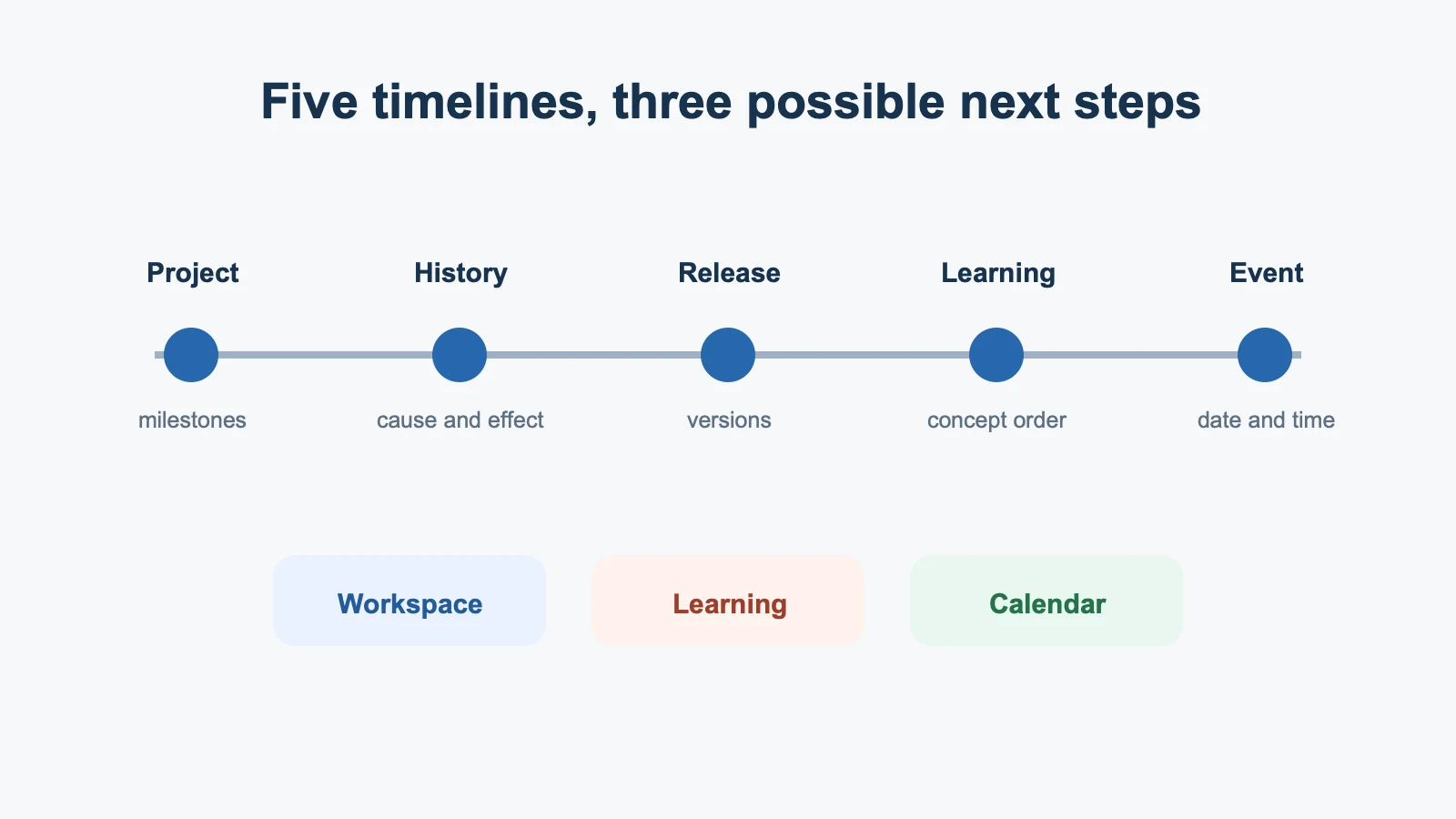
The format works for more than history. Projects, product releases, learning paths, and event plans all become easier to judge when their sequence is explicit. The right next step then depends on the source: export the timeline to a workspace, use it to start deeper learning, or send a genuinely actionable date to Calendar.
1. Project timeline
A project timeline answers practical questions:
- What has already happened?
- Which milestone is next?
- What is blocked by an earlier decision?
- Which deadline belongs on a calendar?
Imagine a product launch with research, prototype, usability test, implementation, and release. A useful timeline connects the stages and records the evidence behind each milestone. It does not reduce the project to a collection of isolated due dates.
Most project timelines belong in a workspace where the team can revise them. Only confirmed meetings and deadlines should move to Calendar. A draft milestone is not the same thing as a scheduled event.
2. Historical timeline
A historical timeline organizes events so cause, response, and consequence can be examined. Dates matter, but the relationships matter more.
For example, a timeline of a policy change might include the proposal, public consultation, vote, effective date, and later amendment. Each point should link back to the source that supports it. The chronology helps readers see where interpretations diverge from documented events.
Historical dates usually do not belong on a personal calendar. They are reference or learning material. This is a case where Start Learning can be more useful than Send to Calendar.
3. Product release timeline
A release timeline can separate states that are often blurred together:
- Code completed
- Build generated
- Internal testing finished
- Store submission made
- Review approved
- Public release available
Those are different claims. A build can exist without being submitted. A submitted version can still be under review. An approved version may be scheduled for later release.
Keeping the states separate makes status reporting more accurate. Put the working timeline in a workspace. Send only real review dates or release appointments to Calendar.
4. Learning timeline
A learning timeline arranges concepts in dependency order. It can show what a learner needs to understand before a later question becomes useful.
For example, a timeline for learning calendar data might begin with dates and local times, then add time zones, recurrence, reminders, and interoperability. RFC 5545 provides the calendar interchange standard behind concepts such as date-time values and time zones. The standard is a source, while the timeline is a reading and reasoning aid.
In Recap, a valuable source can become a question-driven PBL learning session with concise answers, evidence, explanation, reflection, and follow-up questions. Learning is one next step after the document, not the default identity of every timeline.
5. Event timeline
An event timeline is different from a single calendar event. It might include registration, travel, check-in, the main session, and follow-up. Keeping the whole sequence readable helps you decide what belongs on the calendar.
Suppose an event flyer lists:
- Registration closes October 10.
- Doors open October 17 at 1:45 PM.
- The workshop runs from 2:00 to 4:30 PM.
- Feedback is due October 19.
The workshop should be the primary event. Registration and feedback may be separate reminders. The door time can remain a note or alert. The Screenshot to Calendar tool can help with the focused event flow, while the complete screenshot-to-calendar guide explains the field review.
When the timeline begins with a numeric date or several time signals, the guide to extracting a date and time from a screenshot gives a focused ambiguity checklist.
How Recap fits
Recap starts from one source and creates a structured readable Recap Document. That document is the foundation. Afterward, three next steps remain visible:
- Send to Calendar
- Export to Workspace
- Start Learning
When a source contains a strong time-based action, Recap can proactively surface a Calendar Sheet. The user can confirm, edit, or cancel before sending the event. Workspace and Learning remain available at the same time.
That distinction matters for timelines. A chronology should not automatically become a calendar full of dates. The timeline helps you decide which dates are actionable, which belong in a workspace, and which are mainly useful for learning.
Choose the timeline structure
Milestones
Use milestones when distinct outcomes matter: contract signed, prototype approved, release submitted. Avoid filling the timeline with routine activity that does not change project state.
Phases
Use phases when work spans a period: research, design, implementation, review. Show the boundaries and explain what allows the next phase to begin.
Cause and effect
Use cause and effect when the learning value lies in relationships. This is common in history, incident reviews, and policy analysis. Mark uncertainty when one event is correlated with, but not proven to cause, another.
Parallel tracks
Use parallel tracks when several sequences overlap. A launch may have product, legal, marketing, and support tracks. A single line can imply a dependency that does not exist, so separate the tracks and connect only real handoffs.
Source quality still matters
A clean diagram cannot repair weak evidence. Use primary sources for dates and status when they are available. For a calendar event, the organizer's current page is usually stronger than a repost. For a product release, use the official release note or store record. For historical work, distinguish contemporary records from later analysis.
Google Calendar's Events API reference shows how a destination calendar separates summary, description, location, start, and end. That structure is useful after you have decided which timeline point is an event.
A quick decision rule
After building a timeline, ask:
- Does this date require me to be somewhere or do something at a specific time? Consider Calendar.
- Does the sequence need ongoing editing, collaboration, or reference? Consider Workspace.
- Does the sequence reveal a concept or question worth exploring? Consider Learning.
More than one answer can be true. The options are parallel, not a forced funnel.
What changed in this update
The earlier version of this article named five timeline examples but gave each only a brief description. This revision adds decision rules, evidence boundaries, calendar-field guidance, and the current Recap source-to-document-to-next-step model. It also clarifies that Calendar Sheets are surfaced when time matters and remain reviewable before any event is sent.
The result is a more useful timeline guide: one that helps you choose a structure and decide what should happen after the chronology becomes readable.
Continue in Recap
Turn this source into a Recap Document
Make it easier to read, then send time-based details to Calendar, export it to Workspace, or start PBL Learning.